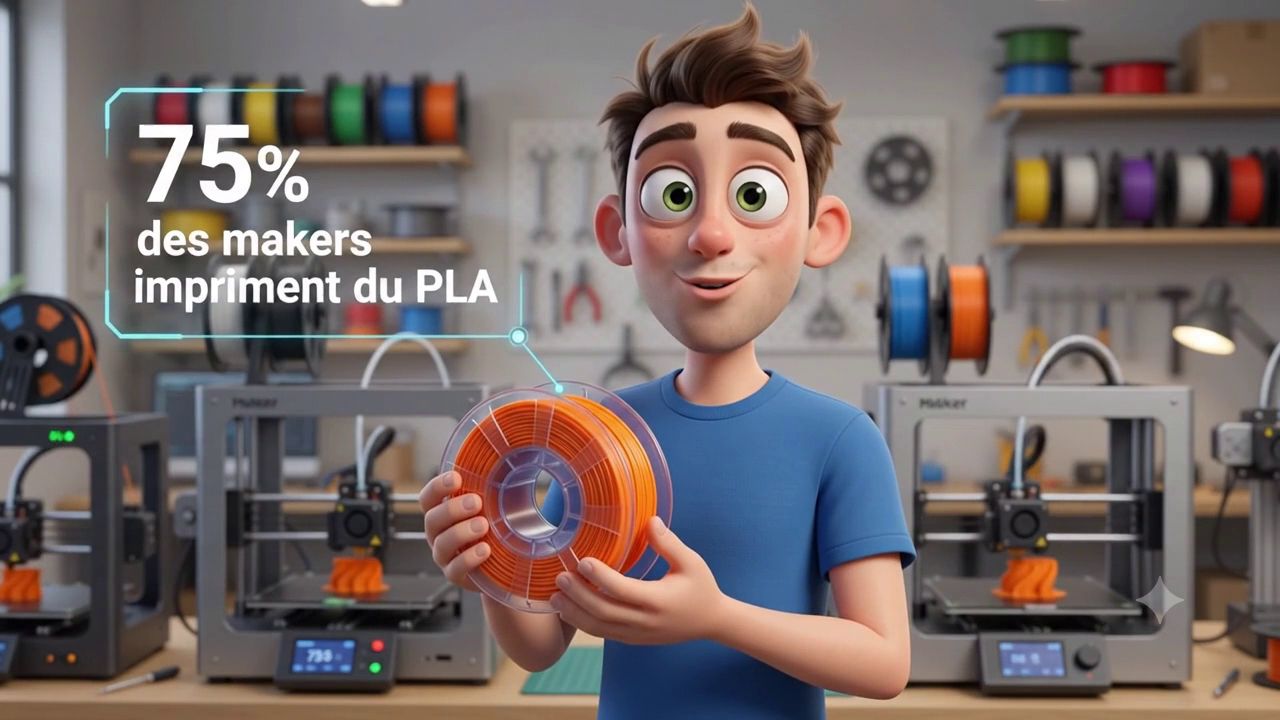
75 % of Makers Print PLA. What About You?
Updated November 18, 2026
If you could only keep one spool on your machine, which would it be? Between the ease of PLA, the durability of PETG, and the technical demands of ABS, every maker eventually picks their go-to material. Let's break it down… then cast your vote!
The percentages below are rough estimates based on what we see in the maker community (forums, community surveys, spool sales)—not official statistics.
✅ PLA: The Absolute King (About 75% of Usage)
It's the default choice for the vast majority of prints among hobbyists.
- Why it: it's the "plug & play" of 3D printing. It prints easily, barely warps, smells minimal during printing, and comes in almost infinite finishes (matte, silk, two-tone, glitter, wood-look).
- Its weakness: poor heat resistance. It starts to soften around 55 to 60 °C: a PLA part left on a car dashboard on a hot summer day quickly turns into abstract art.
✅ PETG: The Practical Compromise (About 15% of Usage)
It's PLA's "workhorse" older sibling. When a part needs to do more than look pretty, many makers switch to PETG.
- Why it: an excellent balance between ease of printing and mechanical strength. It handles heat better than PLA (around 70 to 80 °C), resists water and many chemicals well, and holds up decently outdoors in the shade.
- Its weakness: a tendency toward stringing if retraction isn't dialed in right, and it sometimes sticks too hard to smooth PEI build plates (a thin layer of glue stick acts as a release agent).
✅ ABS and ASA: The Mechanical Classics (About 5% of Usage)
- Why them: solid heat resistance (around 95 to 100 °C) and impact strength.
- The big trend: ASA is slowly taking over from ABS. Its mechanical properties are similar, but it resists UV much better and yellows less: it's the go-to material for outdoor parts.
- Their weakness: an enclosed printer is strongly recommended. Without a chamber, temperature swings cause parts to warp and crack. The fumes released (including styrene) shouldn't be inhaled: ventilate the room or filter the air.
✅ The 3 Rising Stars
- "High-speed" PLA: as fast printers have become common (Bambu Lab, Creality K1 and K2, Prusa Core One…), manufacturers have tweaked PLA's formula so it melts fast enough at 300 mm/s and beyond.
- TPU (flexible): once reserved for experts because it got stuck in extruders, it's now accessible thanks to direct drive hotends: gaskets, RC car tires, phone cases…
- Carbon-fiber-filled filaments (PLA-CF, PETG-CF, PA-CF): micro-fibers make parts much stiffer and more dimensionally stable. Perfect for tool holders, drone arms, or mechanical parts. Warning: these filaments are very abrasive and wear out a brass nozzle in a few hundred grams. Hardened steel nozzle essential.
Your Turn to Vote!
No matter how much we dig into spec sheets, every maker ends up falling for their favorite material: the one you load with your eyes closed before heading to work. What's constantly spinning on your machine?
🗳️ If you could only keep one spool: what's your #1 filament?
Click your answer to vote and see the results.
Tell us in the comments why, and on what printer! To choose the right material for your project, also read our practical guide to picking the right filament.