
3D Printing: The Military Drone Revolution

3D printing has become the "game changer" in modern conflicts, transforming the drone from a costly technological tool into a consumable munition, mass-produced and adapted in real time to front-line needs.
Here's an overview of this industrial revolution in the heart of the trenches.
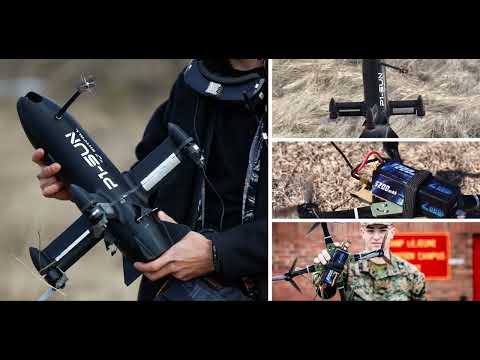
✅ The "Trench Manufacturing": Responsiveness and Agility
The major advantage of 3D printing isn't flight speed, but adaptation speed.
-
Decentralized production: Instead of waiting for shipments from distant factories, military units (particularly in Ukraine) use networks of 3D printers hidden in basements or containers near the front lines.
-
Instant customization: If the enemy changes their jamming frequency, engineers modify the chassis design in just hours to integrate new antennas or different electronic components.
-
Spare parts: 3D printing enables the repair of commercial drones (like DJI) by printing replacement arms, camera mounts, or landing gear.
✅ Beyond the Chassis: Printed Weaponry
Innovation doesn't stop at the airframe structure. Additive manufacturing is now being used to create:
-
Payload release systems: Simple, lightweight mechanisms allowing a civil drone to carry and drop grenades.
-
Munition tail fins: 3D-printed fins are attached to obsolete Soviet-era munitions to stabilize them during vertical drops, turning outdated stocks into precision weapons.
-
Mines and decoys: Recent reports (early 2026) mention Russian forces' use of 3D-printed "Gingerbread" anti-personnel mines, difficult to detect and produced at very low cost.
✅ Reference Models (2025–2026)
| Model / Program | Origin | 3D Characteristic |
| HANX | United States (Marines) | First fully 3D-printed drone certified for U.S. military operations (February 2026). |
| SkyFall P1-Sun | Ukraine | Modular interceptor drone using 3D-printed parts, capable of reaching 450 km/h to chase suicide drones. |
| FPV "Home-made" Drones | Various | Polycarbonate or nylon carbon chassis mass-printed for direct-collision missions. |
✅ Technology Limitations
Despite its effectiveness, wartime 3D printing faces significant challenges:
-
Material quality: Standard plastics (PLA/PETG) resist poorly to temperature variations and UV exposure. Composite materials (Nylon-Carbon) are necessary but more expensive.
-
Technical precision: A poorly printed part can cause vibrations fatal to flight electronics.
-
Electronic dependency: You can print the "body," but not yet motors, chips (SOCs), or optical sensors, which remain dependent on global supply chains.
✅ Why This Is a Revolution
For the first time in military history, the innovation cycle has shifted from years to days. A drone can be designed on Monday, tested on Tuesday, and deployed by the hundreds on Friday.
✅ Safety and Finishing Tips
-
Balance (CG): This is the critical point. A flying wing with its center of gravity too far back is uncontrollable. Check it carefully before the first flight.
-
Bonding: Use medium CA (cyanoacrylate) glue with an accelerator for instant chemical welding of plastic.
-
Painting: Avoid dark colors if you print in PLA, as the sun can deform the structure in minutes on the field (greenhouse effect).
The integration of 3D printing into modern conflict marks a historical turning point: the shift from a rigid, centralized defense industry to an agile, decentralized, and "open-source" production. By turning every basement or container into an armament factory, additive manufacturing has shattered the monopoly of major industrial complexes.
However, this democratization of force raises crucial questions for the future:
-
The innovation race: Success no longer depends solely on firepower, but on how quickly engineers can modify a digital file to counter enemy jamming technologies.
-
Ethics and control: If anyone can print an effective attack vector for a few hundred euros, how do we control the proliferation of these weapons once the conflict ends?
By 2026, the 3D-printed drone is no longer a hobbyist gadget; it has become the symbol of a new era of asymmetric warfare, where software and printers now weigh as much, if not more, than steel and armor.


