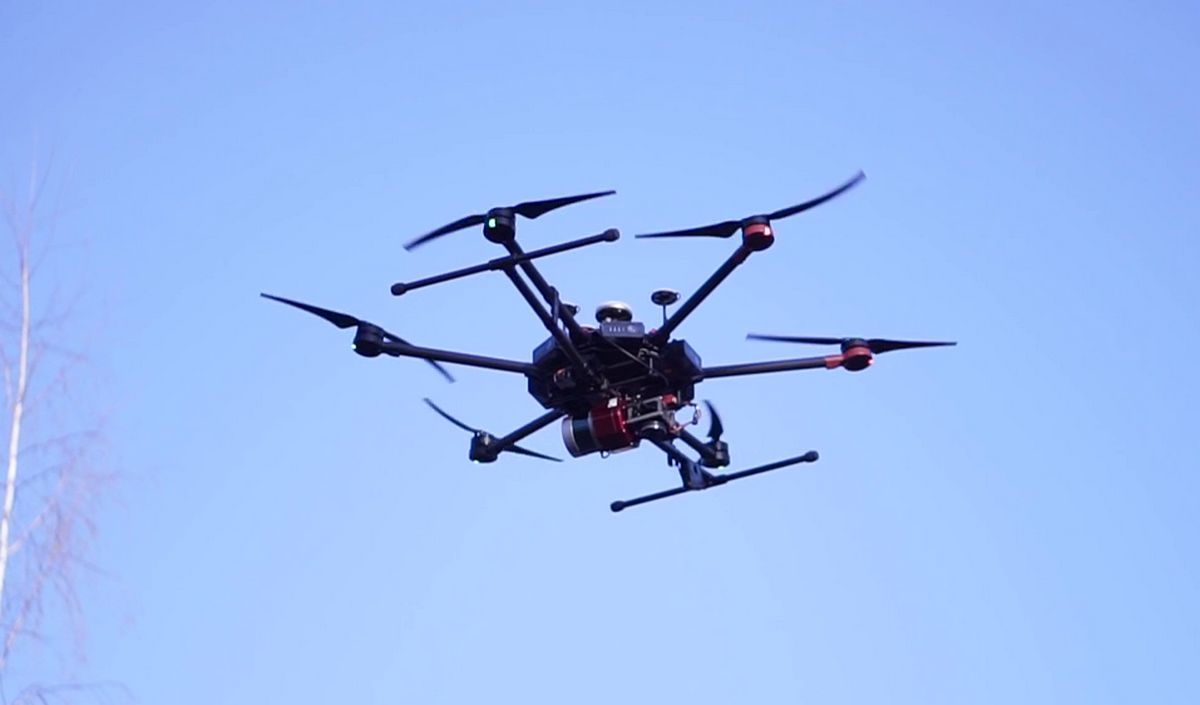
SkyFall P1-Sun: How 3D Printing Powers Next-Gen Drones

The SkyFall P1-Sun has established itself as a major asymmetric technology response in the Ukraine conflict. Far from slow surveillance drones, this model is a hunter-killer unit designed for a single mission: the kinetic interception of enemy reconnaissance drones and loitering munitions.

✅ The additive manufacturing revolution
The secret to the P1-Sun's responsiveness lies in its production method. Its structure is predominantly built using 3D printing with carbon-fiber-reinforced polymers (Nylon-CF).
This technical choice offers two strategic advantages:
-
Industrial agility: The design can be modified in just a few hours via software and reprinted immediately to adapt to new enemy countermeasures.
-
Extreme durability: High-performance 3D printing delivers the structural rigidity the aircraft needs to withstand heavy G-forces during aggressive maneuvers.
✅ Technical specifications and propulsion
From a technical standpoint, the P1-Sun is a masterpiece of responsive engineering, optimized to maximize the thrust-to-weight ratio.
-
Top speed: It's capable of reaching speeds of 450 km/h, a feat made possible by streamlined aerodynamics that drastically reduce parasitic drag (refined motor arms and sleek fuselage).
-
Flight electronics: It carries flight controllers (FC) equipped with high-frequency processors capable of stabilizing the aircraft despite violent turbulence encountered at high speed.
-
Power: Propulsion relies on high-KV motors powered by Li-Po batteries with extreme discharge rates, releasing massive energy in seconds to guarantee lightning-fast acceleration during the interception phase.
✅ Mission: Kinetic interception
Unlike traditional air defense systems costing millions of euros, the P1-Sun offers a "low-cost" solution to neutralize airborne threats. Its operational mode often favors kinetic impact: the drone strikes its target at full speed, using its own mass and velocity to destroy the enemy's rotors or wings.
✅ Strategic advantages
-
Cost-effectiveness: The production cost of a P1-Sun is negligible compared to interceptor missiles, enabling swarm deployments.
-
Decentralized production: 3D printer "farms" can be installed in secure and discreet locations, making the supply chain nearly impossible to fully disrupt.
The SkyFall P1-Sun embodies the future of asymmetric warfare, where 3D printing is no longer just for prototyping but for producing a precision weapon capable of rivaling traditional defense systems. By combining a dizzying speed of 450 km/h with unprecedented manufacturing agility, this drone redefines low-cost air superiority. More than just an aircraft, it's the symbol of agile defense where technological innovation and industrial responsiveness become the most precious ammunition on the modern battlefield.