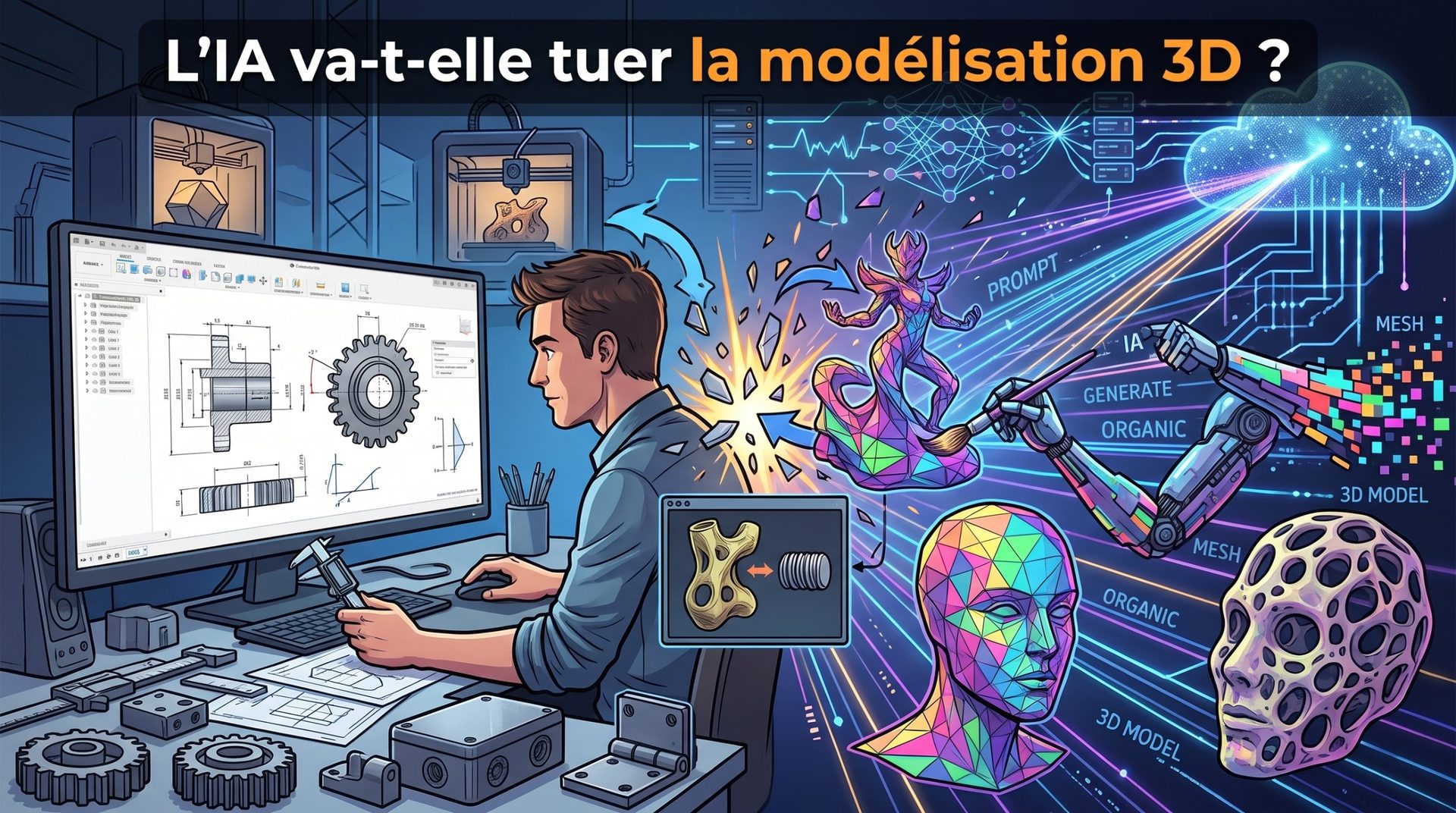
Why Is 3D Modeling Indispensable?

3D Modeling
3D modeling lets you visualize a product from every angle well before physical manufacturing. This makes it easier to understand the design, spot potential problems, and communicate your ideas to teams and stakeholders.
3D models can be integrated into simulation tools to analyze aspects like structural strength, fluid flow, aerodynamics, or ergonomics. This allows you to identify and fix design flaws early on, reducing the risks and costs tied to physical testing.
A precise 3D model is the foundation for many manufacturing processes, including 3D printing, CNC machining, and injection molding. It ensures dimensional accuracy and makes it easier to create manufacturing instructions.
3D renderings can be used for marketing, product presentations, and customer communication long before the final product is available.
Different 3D modeling approaches and techniques:
- Polygonal modeling: The most common approach, where objects are built from a mesh of polygons (usually triangles or quadrilaterals). Perfect for video games and animation.
- NURBS modeling (Non-Uniform Rational B-Splines): Uses mathematical curves to create smooth and precise surfaces, often used in industrial and automotive design.
- Digital sculpting modeling: Similar to traditional sculpting, where you "sculpt" a virtual block of material to refine shapes and add details. Very popular for creating characters or organic objects.
- Volumetric modeling (Voxels): Represents the object as a set of three-dimensional "cubes" (voxels), useful for medical simulations or visual effects.
- Parametric modeling: Used in engineering and architecture, where objects are defined by parameters and relationships (dimensions, constraints), allowing easy and precise modifications.

3D Modeling and 3D Printing: An Inseparable Duo
For 3D printing, 3D modeling is the initial and indispensable step. The 3D model serves as the digital "blueprint" for the printer. Without a precise and optimized 3D file, printing cannot happen or risks failing.
- From Screen to Hand: Modeling lets you design prototypes, spare parts, custom figurines, decorative or functional objects that will then be materialized by your 3D printer.
- Optimization for Printing: A good modeler knows how to create models that are "printable"—accounting for the constraints of the printing technology (minimum wall thickness, overhangs, necessary supports, tolerances).
- Replication and Customization: 3D modeling, often aided by reverse engineering (from 3D scans), allows you to replicate existing objects or modify them for advanced customization.
3D modeling is much more than just a technique; it's a universal language for design, enabling you to transform abstract ideas into concrete forms, from screen to physical object. It's an open door to innovation and creativity in an increasingly three-dimensional world.
👉 Where to start? Here's our selection of 3D modeling software.