The Fascinating Art of Sliced Sculpture in 3D Printing
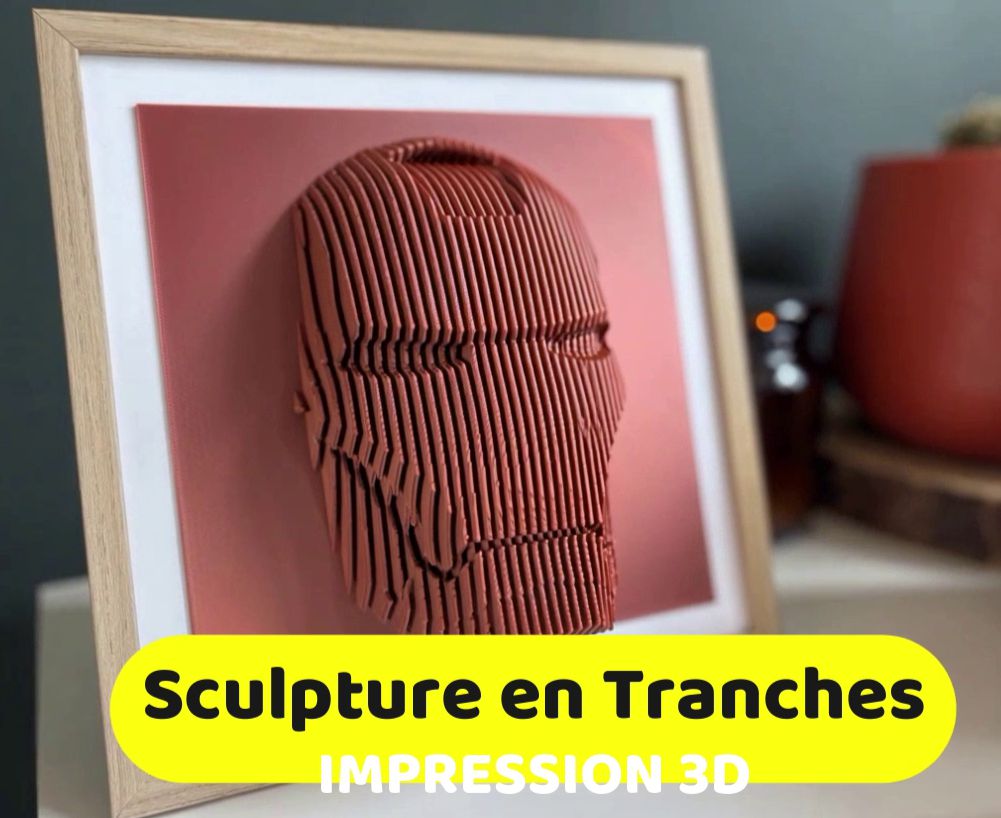
3D printing allows you to deconstruct form in an unprecedented way. Forget classical sculpture; the "sliced sculpture" style (or Sliced Sculpture), as seen in this iconic mask, uses stacking of offset vertical slices to create an illusion of depth, movement, and texture. It's not the printing technique that changes, but the modeling itself.

(Image Source and 3D File: Slevin via MakerWorld)
The Technique: Deconstruct to Rebuild
The effect isn't achieved through printer settings, but through deliberate design in modeling software (CAD or digital sculpting):
- The Slicing Concept: The original 3D model (here, the Iron Man mask) is literally cut into multiple thin vertical slabs (or sometimes horizontal) just millimeters thick.
- Alignment: These slabs are then realigned on a single plane or with a slight progressive offset. Each slab is printed individually or all at once on the build plate, creating an easy assembly.
- Optical Illusion: It's the play of shadow and light between the slices that gives the artwork its power. Viewed head-on, your brain reconstructs the complete mask image. Viewed from an angle, the slices shift, creating a decomposition effect in motion and striking depth.
Aesthetic Impact and Materials
This style has become extremely popular for portraits, busts of famous characters, and logos thanks to its unique rendering:
- Textured Finish: The mask loses its smooth surface and gains a ribbed texture. The design is both modern and sculptural, perfect for contemporary wall décor.
- Colors and Contrast: The key to success is contrast. The slices are printed in one color (often black, bronze, or copper for the metal effect), and the artwork is then mounted on a background of a radically different color (like the copper or red background in the image). This contrast allows the gaps between slices to appear black (shadows), reinforcing the illusion of relief and volume.
- Metallic Filaments: Filaments loaded with metallic particles (Silk PLA, Bronze, Copper) are particularly effective. They capture and reflect light differently on each slice edge, accentuating the decomposed and luxurious side of the artwork.
Printing and Assembly Process
This type of project is often easier to print than a complex sculpture because it's divided into simple components.
- Flat Parts: Since the slabs are mostly flat or slightly curved, they print very well with standard materials like PLA or PETG on FDM machines.
- Assembly: Once the slabs are printed, assembly is simple: they're glued together or inserted into a support (often a 3D-printed base or a groove in a frame) that maintains precise spacing and alignment.
Sliced sculpture is proof that 3D printing doesn't just reproduce form—it reinterprets it, offering an aesthetic of a new kind where deconstruction equals modernity and artistic depth.