Arc Reactor MK1 Iron Man Replica
The Arc Reactor MK1 is more than just an energy source; it's the symbol of Tony Stark's genius, the emblem of his redemption, and the origin of the Iron Man armor. Created under primitive conditions, this feat of improvisation is an exciting cosplay and modeling project. Thanks to 3D printing, any maker can now recreate this iconic replica, combining precision printing with integrated LED lighting effects.

(Image Source and 3D File: Mc2.project3D via MakerWorld)
The Modeling
Unlike the cleaner later versions (MK2 and beyond), the Arc Reactor MK1 has a rough, improvised aesthetic that reflects its creation in the cave.
- Industrial Style: The 3D modeling (often done in software like Fusion) should emphasize the bolts, visible welds, and disjointed parts that give this "raw prototype" look.
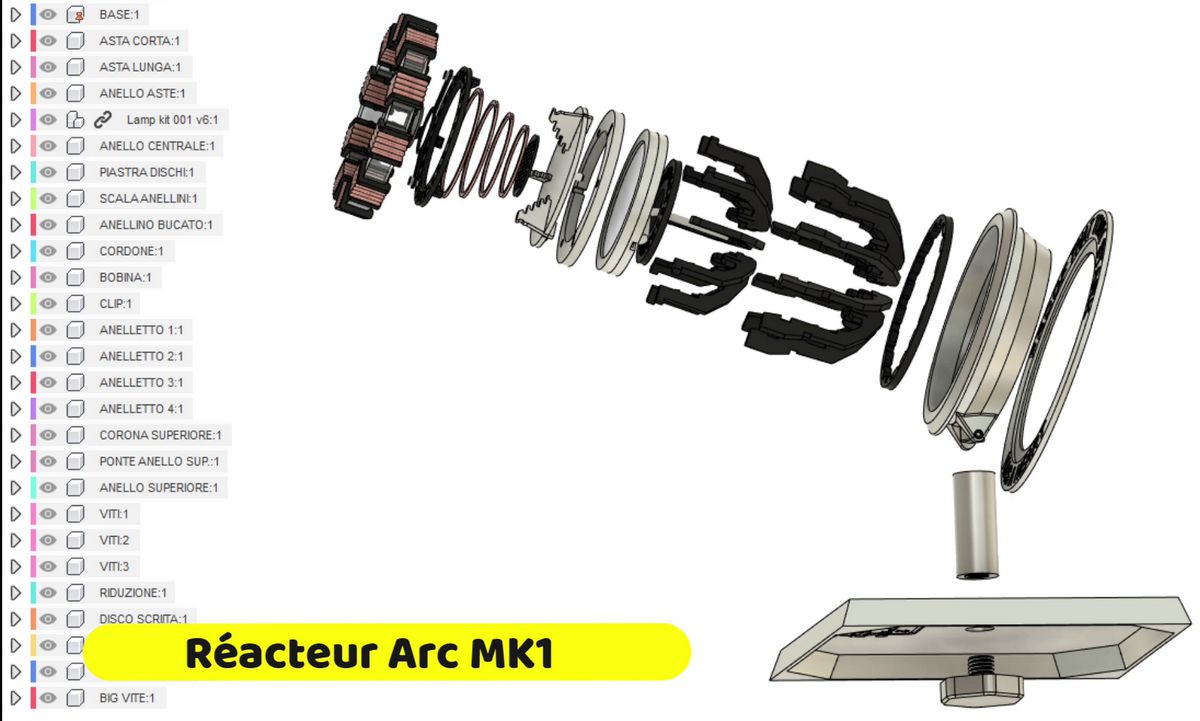
- Modular Design: The Arc Reactor is a mosaic of multiple components (the outer ring, copper wires, central grid). To simplify printing and finishing, the models are designed as separate pieces:
- The main rings (often printed in gray, black, or silver).
- Support bars and coils (often printed in copper or gold).
- The central light diffuser (the essential piece for lighting).
Lighting: The Heart That Glows
The success of the replica lies in the brilliant blue light. 3D printing is perfectly suited for integrating electronics invisibly.
A. Printing the Diffuser
The light must be soft and evenly distributed.
- Material: The central diffuser and sometimes the ring are printed with transparent or white translucent filament (PLA or PETG).
- Technique: Printing should be done with a low infill percentage () to maximize light diffusion and avoid overly intense hotspots.
B. LED Integration
- Light Sources: The most common solution is to use an LED ring (often WS2812B models) or simple round LED lighting.
- Assembly: The 3D housing is designed with internal grooves or slots that hold the LED strip and wiring perfectly in place, usually hidden behind the outer "metal" ring.
- Interactivity: Advanced makers integrate microcontrollers (like Arduino or ESP8266) to program sophisticated lighting effects: the reactor's initial flash, subtle pulsing, or the famous "Proof that Tony Stark has a Heart" inscription.
Finishing: From Plastic to Aged Metal
The most critical step is making the plastic look like weathered metal.
- Preparation: Sand to remove layer lines, especially on smooth surfaces, followed by a gray primer coat.
- Base Paint: Apply matte black or dark gray paint on structural pieces to simulate base metal.
- Metallic Effect: Use high-quality copper, gold, and silver metallic paints (model-grade). A dry brushing technique can simulate wear and add relief to details.
- The Wires: Some models require adding real, very fine copper wire wrapped around the 3D-printed pieces for maximum detail and to emphasize the "DIY" aspect of the MK1 prototype.
Thanks to 3D printing, the Arc Reactor MK1 is no longer a science-fiction object, but an accessible crafting project that lets every fan own a piece of Iron Man's legacy.