Robotic Arms: The Future of 3D Printing?

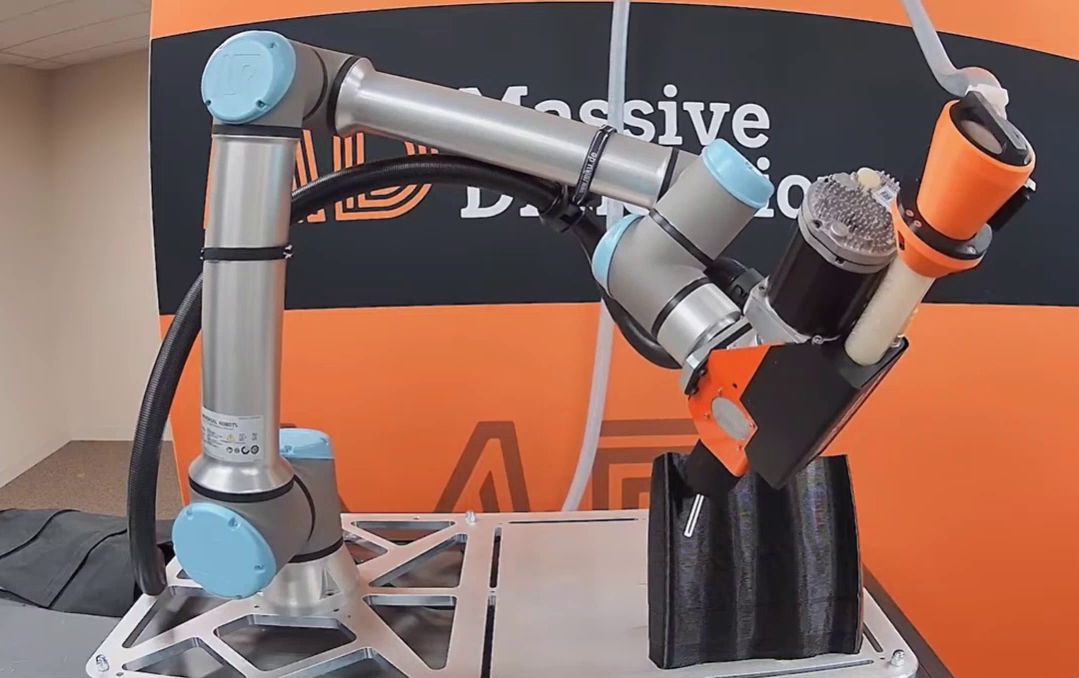
Traditional 3D printing, while effective, is often limited by its "box": the build volume is constrained by the cartesian axes (X, Y, Z) of an enclosed machine. The emergence of robotic arms is changing the game by transforming 3D printing into a "free-form" fabrication process.
Here's why the robotic arm represents the logical evolution of additive manufacturing.

✅ The end of volume limitations
Unlike traditional 3D printers mounted on gantries, an articulated arm can reach complex angles and cover a much larger work area.
-
Extended reach: By mounting an arm on rails, you can print structures several meters long (houses, bridges, boat hulls).
-
Mobility: Some robots are mounted on mobile bases to move directly to the construction site.
✅ Six-axis printing (and beyond)
Where a standard printer deposits flat horizontal layers, the robotic arm uses multidirectional freedom of movement.
-
Support reduction: By tilting the print head, the robot can print overhangs without needing sacrificial support structures.
-
Structural strength: The robot can deposit material along the stress lines of a part, making the final object much stronger than a traditional layer-by-layer print.
✅ Material versatility
The robotic arm is more than just a plastic extrusion head. It's a versatile tool capable of handling:
-
Concrete: For the construction sector (printing insulating walls).
-
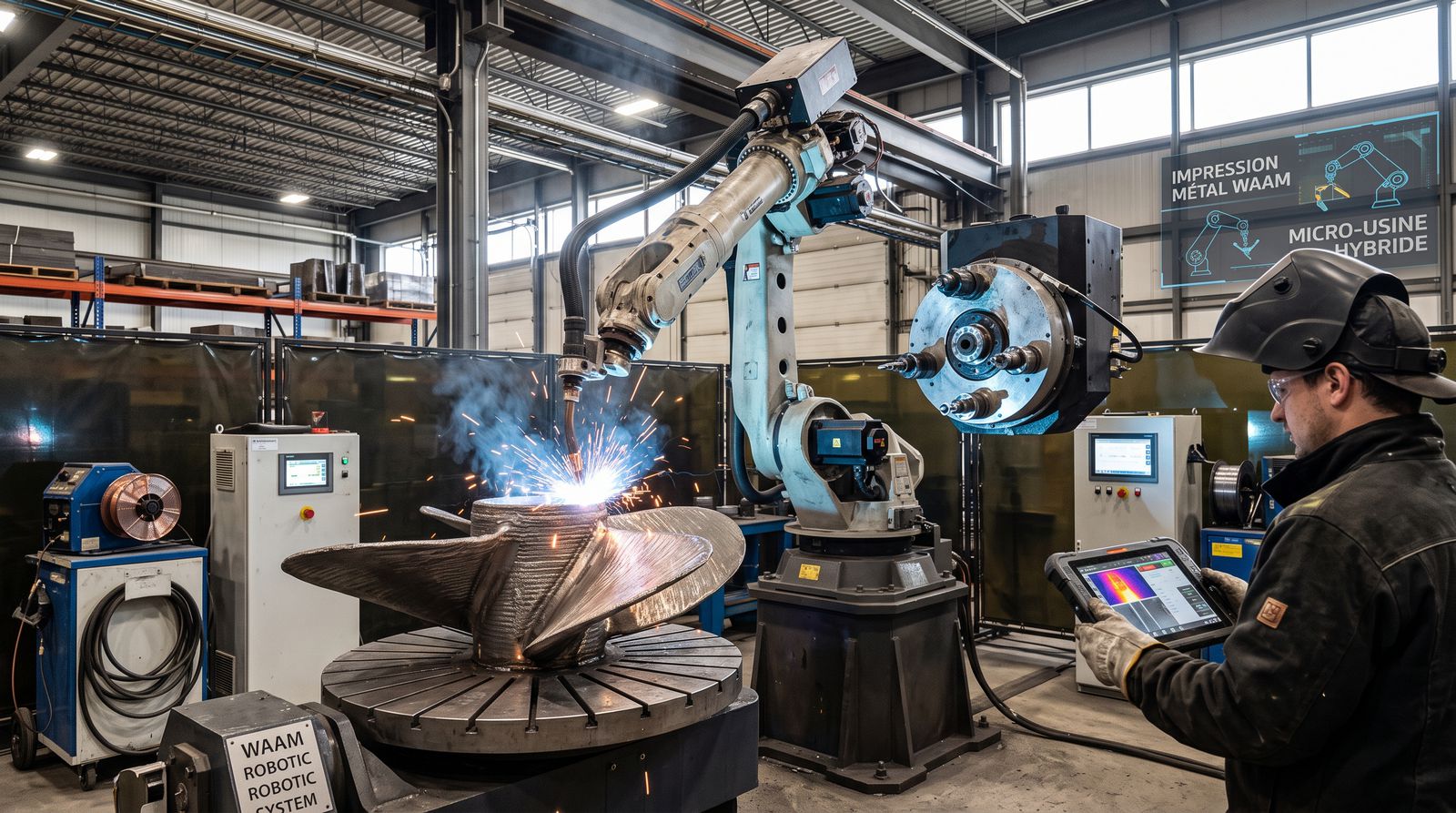
Metal: Via WAAM (Wire Arc Additive Manufacturing), using arc welding.
-
Composites: Continuous carbon fiber for aerospace.
✅ A hybrid system: Fabrication and finishing
The future of robotic 3D printing lies in its ability to change tools (ATC - Automatic Tool Changer). A single arm can:
-
Print the raw shape.
-
Machine (mill) surfaces for perfect precision.
-
Inspect the part via laser sensors.
✅ Comparison: Traditional printer vs robotic arm
| Feature | 3D Printer (Cartesian) | Robotic Arm |
| Degrees of freedom | 3 axes (X, Y, Z) | 6 axes or more |
| Build volume | Limited by frame | Nearly unlimited (if on rails) |
| Complexity | Simple horizontal layers | Complex non-planar geometries |
| Cost | Affordable (consumer) | High investment (industrial) |
Is the robotic arm the future? Yes, for industry and construction. It frees 3D printing from its cage and enables the transition from producing small prototypes to manufacturing massive architectural and aerospace structures.