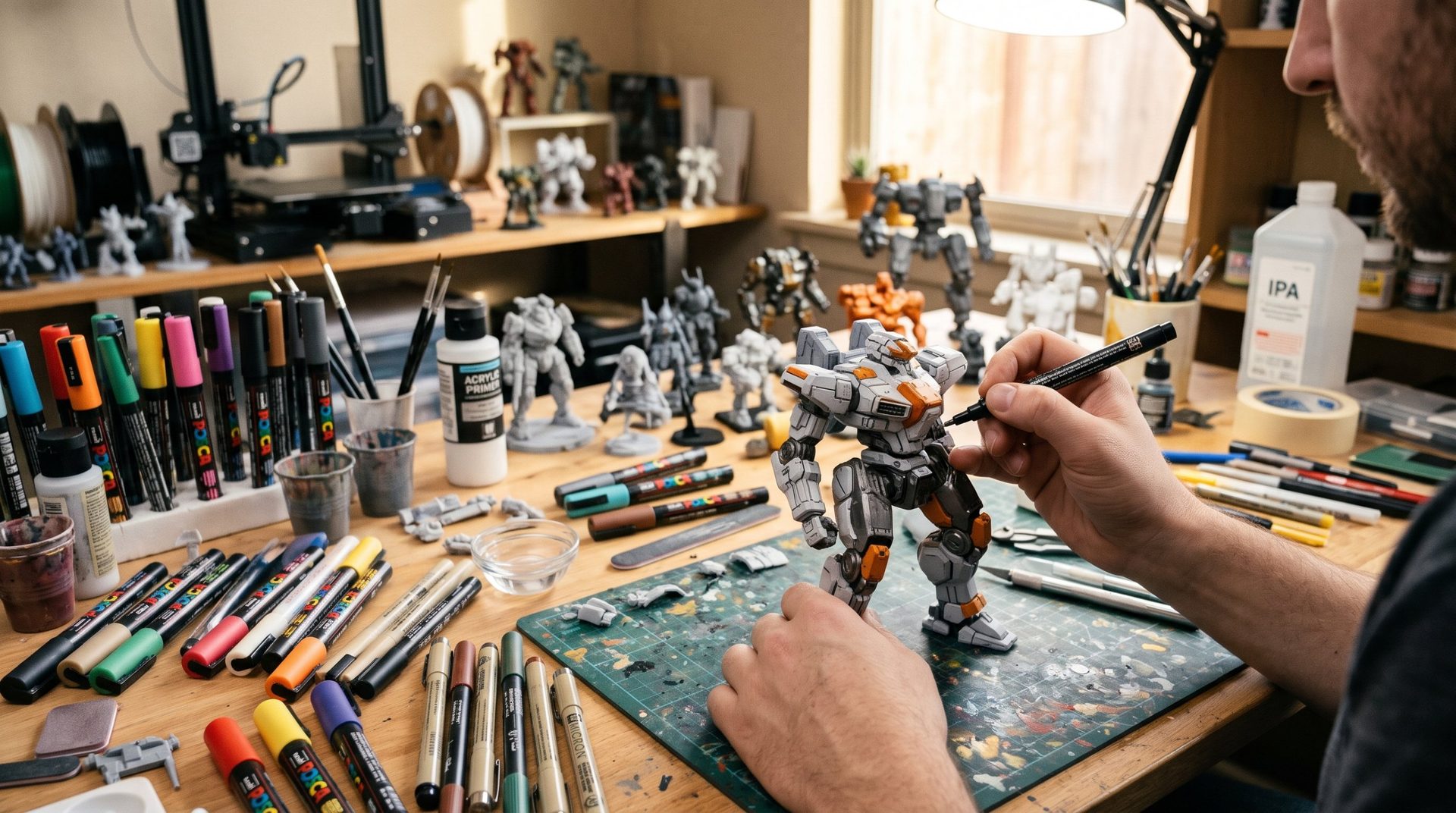
Painting Guide for 3D Prints: Bring Your Creations to Life

Once your 3D print is complete, painting is the step that will truly bring it to life. Whether you want a realistic look, a smooth and glossy finish, or simply a touch of color, choosing the right paint is crucial. It depends not only on the desired result, but also on the type of filament used. Here's a guide to help you select the right paints and achieve professional results.
The essential step: preparation

Whatever paint you choose, good preparation is the key to success.
- Clean and smooth: Remove support structures, sand visible layers or imperfections, then clean the part with soapy water or isopropyl alcohol to remove any traces of grease or dust.
- Primer: This is the most important step. A plastic primer allows the paint to adhere perfectly to the surface and creates a uniform base. Without it, the paint could chip easily.
Different types of paint for 3D printing
Each paint type has its own advantages and disadvantages.
1. Acrylic paints
This is the most common and versatile option for painting 3D prints, as they are easy to use and offer excellent results.
- Advantages: Water-based, they are low-toxicity and easy to clean. They dry quickly, offer a wide range of colors, and are ideal for fine details applied with a brush or airbrush.
- Disadvantages: Less resistant to scratches without a protective varnish coat.
- Ideal for: Figurines, models, detailed prototypes.
2. Spray paints (aerosol)
Perfect for larger pieces or to apply a base coat quickly and evenly.
- Advantages: Fast and uniform coverage, offering a very smooth finish.
- Disadvantages: They can be difficult to control for details and require good ventilation. Be aware that some "aggressive" spray paints can attack certain plastics like PLA.
- Tip: Choose spray paints specifically designed for plastic. Always apply several thin coats rather than one thick coat to avoid drips and damage to the filament.
3. Enamel and lacquer paints
These are renowned for their great durability and glossy finish, very smooth and resistant.
- Advantages: Very robust and resistant to impacts once dry. High-quality finish.
- Disadvantages: They release toxic fumes and require excellent ventilation. Drying time is longer and they can be more difficult to apply for beginners.
- Ideal for: Functional parts, accessories, or any print requiring a very durable finish.
4. Metallic and special effect paints
These paints allow you to achieve specific finishes for creative projects.
- Advantages: They can mimic the look of metal, rust, stone, or other textures for striking realism.
- Use: Costumes, film props, decorative objects.
Which paint type for which filament?
- PLA and PETG: These filaments are the easiest to paint. Acrylic and plastic spray paints work perfectly.
- ABS: ABS is very receptive to paint. After acetone smoothing, it offers an exceptionally smooth surface, ideal for any type of paint.
- Resin (SLA/DLP): Resin prints already have a smooth surface, making them ideal for painting. A primer is highly recommended before applying acrylic or spray paint for a perfect finish.
Here are some of the most popular and best-suited brands:
For figurines and fine details (Hobby Paints)
These brands are ideal if you work on miniatures, figurines, or pieces requiring great precision. They are often packaged in bottles with droppers, which makes them easy to use.
- Vallejo: One of the reference brands in the modeling world. Its "Model Color" and "Game Color" ranges are particularly appreciated for their covering power, pigmentation, and ease of application with brush or airbrush.
- Citadel (Games Workshop): Very popular for role-playing game figurines, this brand offers a wide palette of vibrant colors and evocative names. The ranges are well-structured (Base, Layer, Shade) to facilitate the application of different coats.
- Army Painter: Designed for painting armies of figurines, this brand offers paint kits and tones that work well together. Their "Speedpaint" is very effective for beginners because it applies color and shadows in a single coat.
For larger projects (Artist Paints)
If you're working on larger pieces or decorative objects, these brands are an excellent choice, often more economical for larger quantities.
- Liquitex: Recognized for the quality of its pigments and wide range of colors. The "Basics" range is an affordable option to get started, while the "Heavy Body" range offers a thicker consistency, ideal for textured finishes.
- Pébéo: A French brand commonly found in art supply stores, offering quality acrylic paints with excellent pigmentation at a reasonable price.
Partner links:
- Vallejo: https://amzn.to/3UeEoSa
- Citadel (Games Workshop): https://amzn.to/456e6Yw
- Army Painter: https://amzn.to/4m76wTF
- Liquitex: https://amzn.to/3H4xNa1
- Pébéo: https://amzn.to/3HeBtpI
In conclusion, painting is an art in itself, and the right combination of good sanding, appropriate primer, and the ideal paint type is the secret recipe for enhancing your 3D creations.