MEMS Accelerometers: Physics Behind Input Shaping
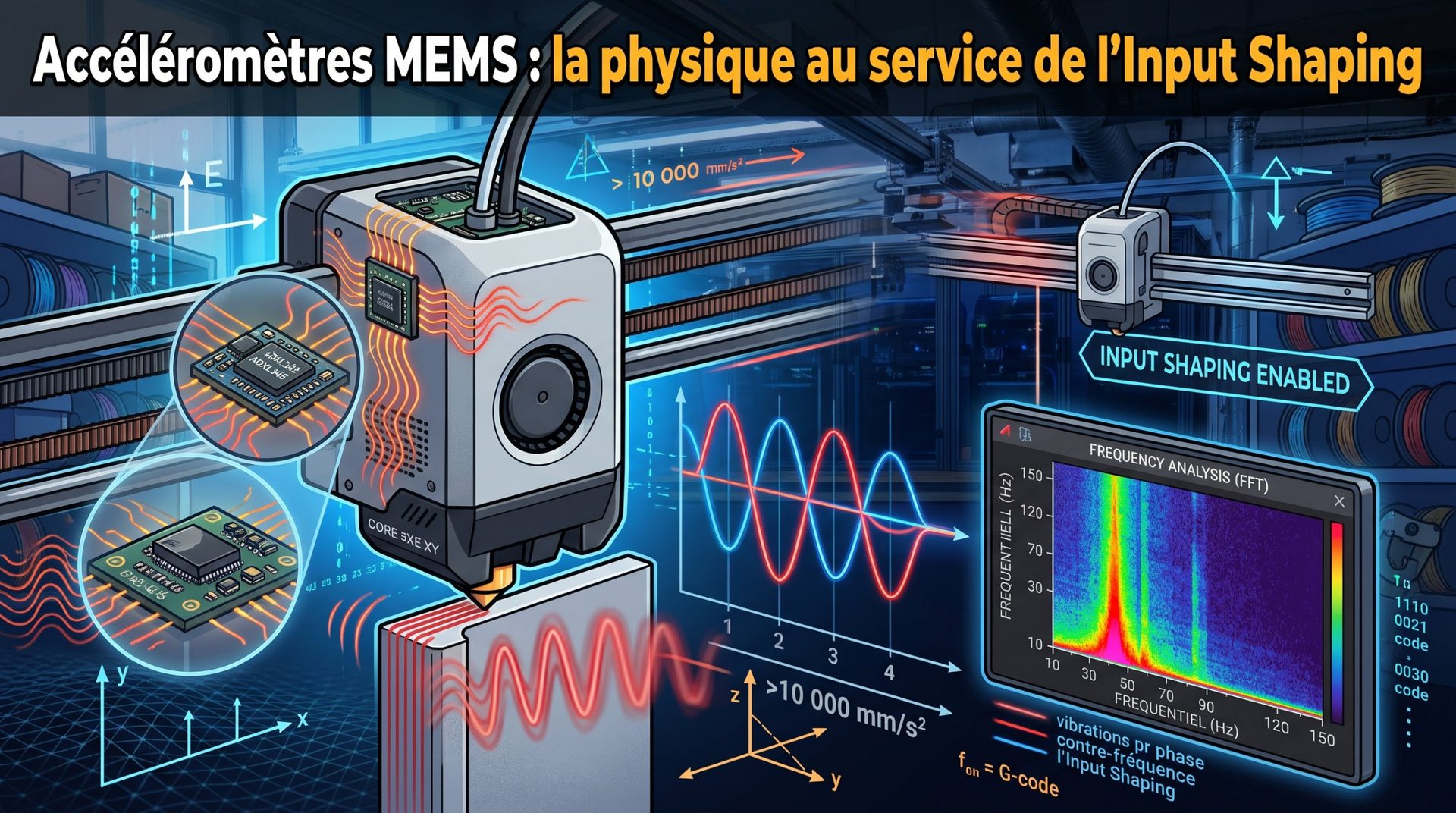
The explosion in print speeds enabled by CoreXY machines quickly hit a wall that engineers know well: resonance. Pushing a print head beyond 10,000 mm/s² of acceleration subjects belts, bearings, and aluminum frames to violent jerks.
Every abrupt direction change, especially in corners, injects energy into the structure. Since this energy can't dissipate instantly, it makes the machine vibrate at its natural frequencies. The result on your part is immediate: the ringing effect (ringing or ghosting)—those ripples that repeat on walls after each corner.
To sidestep this limit without loading the frame with dozens of kilos of steel, 3D printing adopted two technologies from elsewhere: the MEMS accelerometer, the same one in our smartphones, and input shaping, a control technique born in robotics in the 1990s.
1. The Technology: A Microscopic Sensor Etched into Silicon
The sensors used, like Analog Devices' ADXL345 or STMicroelectronics' LIS2DW, are micro-electromechanical systems (MEMS):
- Inside: a tiny mass, suspended by micro-springs etched into silicon, shifts under acceleration.
- The measurement: this movement changes the gap between fixed and moving electrical combs. The resulting capacitance shift is converted to a digital signal and sent to the printer's controller.
- The setup: the sensor mounts on the print head (and on the bed for the Y axis on bed-moving printers). It measures acceleration on all three axes, up to 3,200 times per second for the ADXL345.
2. How It Works: Vibrate the Machine to Listen to It
The accelerometer usually doesn't run during printing—it acts as a measurement instrument during calibration. The principle, in four steps:
- The sweep: the machine oscillates the head faster and faster, roughly 5 to 130 Hz with Klipper.
- Resonance: when the motion frequency matches the natural frequency of the belt or gantry, vibrations amplify sharply.
- Recording: the MEMS sensor logs these vibrations continuously.
- Analysis: the firmware (Klipper, RepRapFirmware…) applies a fast Fourier transform (FFT) that breaks down the signal into frequencies. The highest peak reveals each axis's natural frequency—for example, 48 Hz on X and 38 Hz on Y.
On recent "plug-and-play" printers, this calibration launches automatically during setup; on Klipper, a single command does it, and the firmware recommends the best-fitting filter itself.
3. Input Shaping: Cancel One Vibration with Another
Knowing the vibration frequency does nothing if you can't cancel it. That's the job of input shaping filters. Rather than send a brutal motion command, the algorithm breaks it into several impulses, timed with great precision. In its simplest version:
- the first impulse starts the head moving and triggers a vibration;
- the second is sent exactly half an oscillation later—it creates an identical but inverted vibration;
- the two cancel each other out. By the corner's exit, almost no vibration remains.
Main Filters
Depending on machine stiffness and resonance peak sharpness, several filters are available. The more tolerant a filter is to frequency variation, the more it slightly rounds corners:
| Filter | Tolerance to Frequency Deviation | Vibration Reduction | Corner Rounding |
|---|---|---|---|
| ZV (Zero Vibration) | Low: frequency must be very accurate | Excellent on a sharp peak | Minimal, crisp corners |
| MZV (Modified ZV) | Good | Very good: often the best compromise | Low |
| ZVD (ZV and Derivative) | Good | Very good | More pronounced |
| EI, 2HUMP_EI, 3HUMP_EI ("Extra Insensitive") | Very high: broad or multiple peaks | Maximum on flexible machines | High, slight sharpness loss on small details |
For a well-built machine, Klipper most often recommends MZV or EI; ZV suits very rigid structures with a sharp resonance peak.
Speed and Quality, Finally Reconciled
The arrival of MEMS accelerometers solved one of 3D printing's oldest dilemmas: choosing between speed and surface quality. By letting a printer clear corners at over 10,000 mm/s² while keeping walls smooth and free of ripples, this small sensor turned a mechanical problem into simple math for the machine's processor. One other limit remains, though input shaping won't fix it: the head's ability to melt plastic fast enough. Read our article on filament as the real speed bottleneck, and our take on the max speed you can realistically expect.