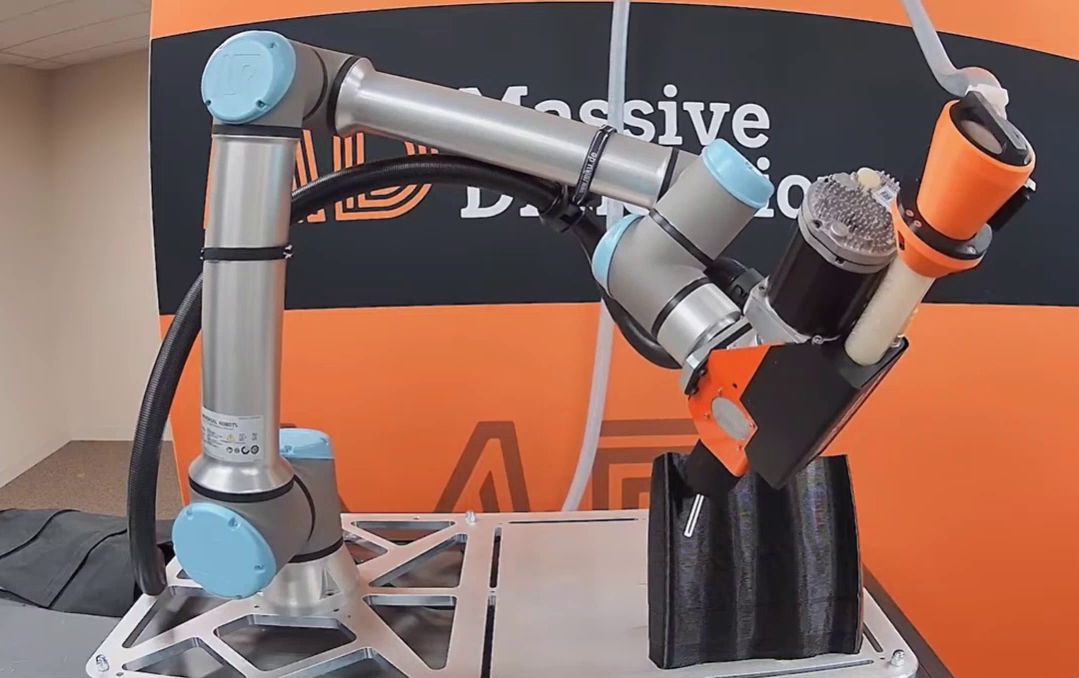
LeRobot by Hugging Face: Combining AI and 3D Printing to Build Your Own Robotic Arm

For years, Hugging Face has been the go-to platform for text (NLP) and image AI. Now they're taking on the physical world with LeRobot, an open-source library designed to democratize robotics, from simulation to real-world manipulation.

✅ What is LeRobot?
Unlike expensive industrial robots, LeRobot is a software ecosystem that lets you share data, train AI models, and control affordable robotic arms.
-
Goal: Make robotics as accessible as generative AI.
-
Approach: Use imitation learning. Instead of programming every movement, you "show" the robot how to do it, and it learns.
✅ The Star Robotic Arm: The Koch v1.1 / SO-ARM
To support this software, Hugging Face highlights robotic arms often built with:
-
3D-printed parts (free CAD files).
-
Affordable servo motors (Dynamixel type).
-
Simple assembly you can do yourself for €300–€500.
✅ Why is this a game-changer?
Before LeRobot, advanced robotics required complex proprietary software and machines costing tens of thousands of euros.
| Feature | Traditional Robotics | LeRobot Approach |
| Cost | Very high (€10k+) | Affordable (<€500) |
| Software | Proprietary / Rigid | Open-source (Python/PyTorch) |
| Learning | Line-by-line programming | Learning from demonstration |
| Sharing | Closed | Community-driven (Hugging Face Hub) |
✅ How does it work in practice?
The process typically follows three key steps:
-
Teleoperation: You manually manipulate the arm (or a master arm) to pick up an object.
-
Recording: The software records camera images and motor positions.
-
Training: The AI (often using Diffusion Policy models) learns the connection between what the camera sees and the movement to perform.
-
Inference: The robot reproduces the task autonomously, even if the object is slightly moved.
✅ Where to find the resources?
If you have a 3D printer and a DIY spirit, everything is available on their official GitHub:
-
Code:
huggingface/lerobot -
Models: Hundreds of datasets are already hosted on the Hugging Face Hub so you can test your arms without starting from scratch.
Bottom line: Hugging Face wants to create the "Linux of robotics." By combining low-cost arms and collective intelligence, they're opening the door to household robots capable of folding laundry or tidying a table within a few years.