
Delta 3D Printers

In the diverse landscape of FDM (Fused Deposition Modeling) 3D printing, where Cartesian printers reign supreme, Delta 3D printers stand out with their unique architecture and graceful movement. Recognizable by their slender triangular frame and fixed circular build plate, these machines offer a different approach to additive manufacturing, focused on speed and the ability to print tall objects.
How Does a Delta 3D Printer Work?
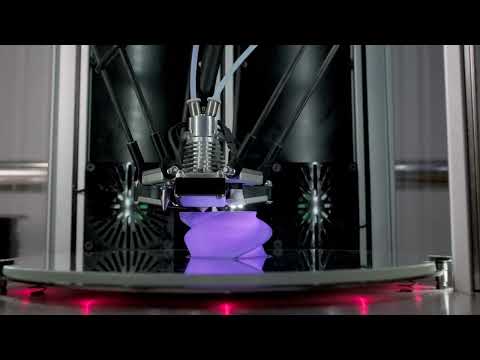
Unlike Cartesian printers (like the popular Ender or Prusa i3) that move the print head along perpendicular X and Y axes and the build plate in Z, Delta printers use an approach based on trigonometry.
- Three Articulated Arms: The print head (extruder) is suspended by three lightweight articulated arms. These arms are connected to three vertical towers (the Z axes).
- Static Motors: The motors that control the movement of each arm are typically fixed to the base of the printer and don't move with the head. This is a key advantage: by keeping heavy components stationary, the print head remains very light and agile.
- Coordinated Movement: The movement of the print head in space is the result of complex trigonometric calculations that coordinate the movements of all three arms simultaneously. This is what gives Delta printers their distinctive, fast, and fluid motion.
- Fixed Build Plate: The build plate is typically circular and remains stationary. The print head does all the work of moving in X, Y, and Z.
The Distinctive Advantages of Delta 3D Printers
Delta printers stand out with several strengths that make them attractive for specific applications:
- High Print Speed: Thanks to the lightweight nature of their print head and reduced inertia (heavy motors don't move), Delta printers are renowned for superior print speeds, significantly reducing build times.
- Printing Tall Objects: Their vertical design gives them impressive print height, making them ideal for printing tall, slender objects like vases, sculptures, or architectural columns.
- Smooth Surface Quality: Fluid movements and minimized direction changes can result in smoother print surfaces and better visual quality, especially on cylindrical or curved objects.
- Captivating Design: Watching a Delta printer work is mesmerizing. The coordinated arm movement is fascinating and adds an aesthetic dimension to the printing experience.
- Small Footprint: For a given print height, a Delta often occupies less floor space than a comparable Cartesian printer.
Challenges and Considerations
Despite their strengths, Delta printers present certain challenges:
- Calibration Complexity: Initial build plate calibration and arm adjustment can be more complex than on a Cartesian printer, requiring a good understanding of trigonometric principles for optimal accuracy.
- Limited Print Diameter: While excellent in height, their circular build plate limits the maximum diameter of objects, making them less suitable for large, flat parts.
- Less Suited for Absolute Beginners: The complexity of their kinematics can make them somewhat less "plug-and-play" for newcomers compared to some very user-friendly Cartesian printers.
- Access Difficulty: The fixed build plate and workspace surrounded by arms can sometimes make accessing the part during printing or removing it slightly more challenging.
Applications and Popular Brands
Delta printers are prized in fields where speed and production of tall objects are priorities, such as rapid prototyping, artistic sculpture creation, decorative vases, or architectural pieces.
Among the recognized brands offering Delta printers, you'll find notably:
- FLSUN: Very popular for its fast and affordable models like the FLSUN Super Racer (SR) or the QQ-S Pro.
- WASP: Specializes in large-scale Delta printers, including those for printing clay materials or concrete for construction.
- TRILAB: Offers professional and industrial Delta printers.
- Historically, projects like the Kossel popularized Delta architecture in the RepRap community.
In summary, Delta 3D printers represent a fascinating and high-performance alternative to Cartesian models. They excel where speed, height, and the aesthetic quality of movement are key assets, offering a unique printing experience and impressive results for those who master their particularities.


