Chemical Smoothing in 3D Printing: How to Get an Injection-Molded Look Safely
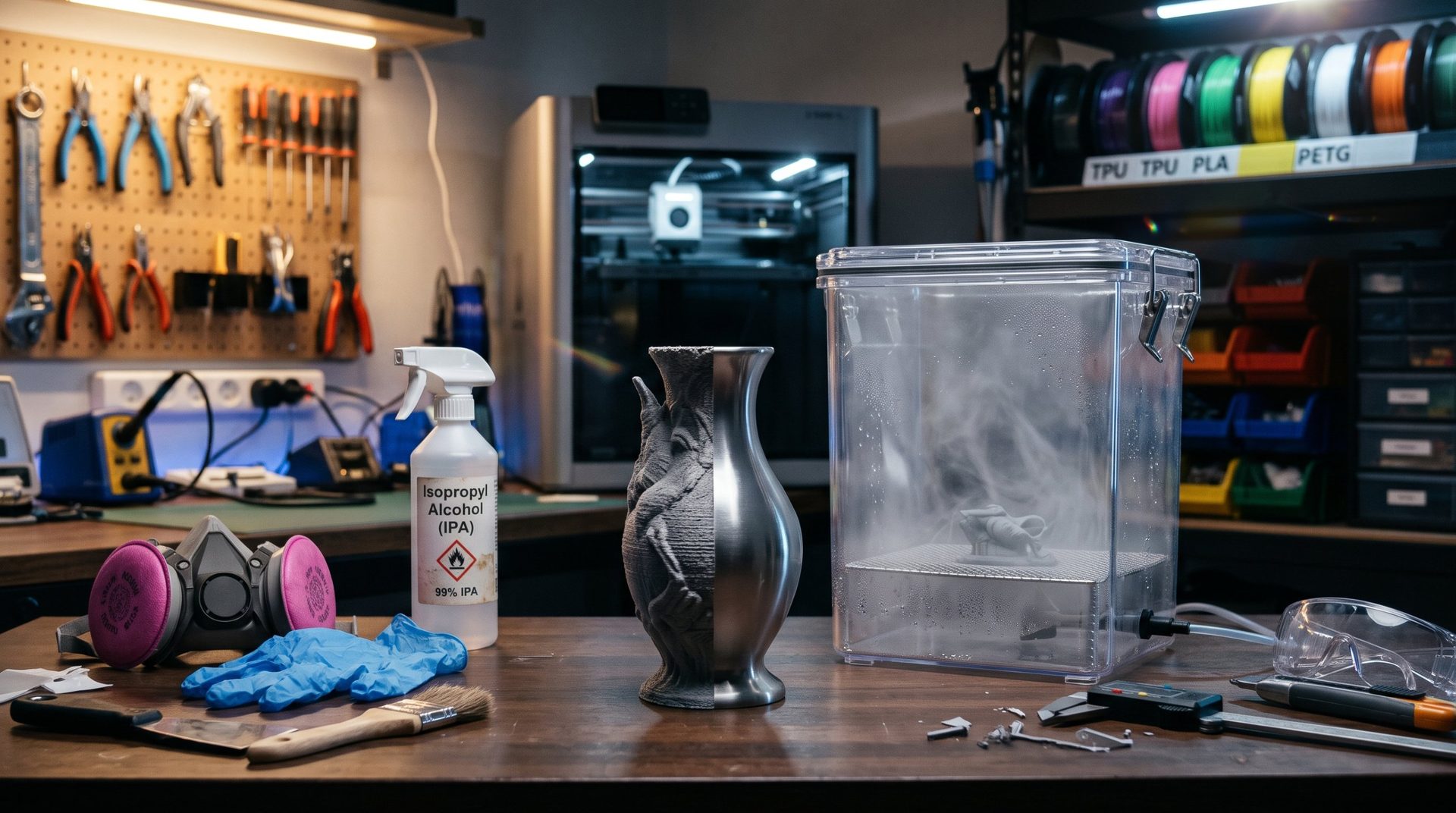
Solvent vapor smoothing (vapor smoothing) is the aesthetic holy grail of FDM 3D printing. By slightly dissolving a part's surface, the solvent makes material flow into the grooves between layers. Print lines vanish and give way to a smooth, glossy finish worthy of an injection-molded factory part.
Historically, this technique is inseparable from the ABS + acetone combination. But acetone poses real problems in a home workshop: its vapors are highly flammable (flash point around −20 °C), can ignite in confined spaces, and irritate the respiratory tract. And ABS itself requires a closed printer and releases styrene vapors during printing.
Are there safer solutions, or ones suited to PLA and PETG? Here's the complete breakdown: which solvent for which plastic, safety rules, and the real effect on your parts.
1. Which solvent for which filament?
Not all plastics react to the same products. Acetone has little and irregular effect on PLA, and PETG resists common solvents very well, making it very hard to smooth.
| Filament | Solvent | Risk Level | Workshop Feasibility |
|---|---|---|---|
| PVB | Isopropyl alcohol (IPA) | Low to moderate: flammable, but far less toxic than other solvents. | Excellent: the safest and most accessible method. |
| ABS / ASA | Acetone | High: highly flammable, heavy vapors that accumulate at ground level. | Moderate: sealed box, no heat sources or electrical appliances. |
| PLA | Ethyl acetate | High: flammable, persistent odor, irritating to airways. | For experienced makers only, with good results only on certain PLAs. |
| PETG | Chlorinated solvents | Critical: toxic, proven or suspected carcinogens. | Avoid at home: prefer sanding, filler primer, or varnish instead. |
2. PVB + isopropyl alcohol: the safest solution
To achieve a glossy finish without handling dangerous products, PVB (sold for example under the PolySmooth name by Polymaker) is today the best option:
- During printing: it prints almost like PLA (nozzle around 190–220 °C, warm bed), with very little odor.
- Smoothing: no need to heat. Spray thin coats of isopropyl alcohol, letting it dry between passes, or use a dedicated device that diffuses an alcohol mist in a closed chamber. Expect about 20 to 45 minutes depending on the method.
- The result: layer lines disappear almost entirely, and translucent shades gain noticeably in transparency.
3. How smoothing changes your part
Chemical smoothing doesn't just change appearance: it transforms the part too.
A. Less precision
By softening, the material fills grooves but also rounds sharp edges. Fine threads (M3, M4) clog and holes tighten. Expect a loss of 0.1 to 0.3 mm on contours: plan for this from the design stage for parts with tight fits.
B. Tightness versus rigidity
- The gain: the melted surface closes micro-gaps between layers. The part becomes much more watertight and airtight.
- Temporary loss: absorbed solvent softens the plastic. When removed, the part is often soft to the touch: let it air-dry 48 to 72 hours before handling or putting it under stress.
- Weakening: if solvent acts too long, the part loses some rigidity. Better several short exposures than one too long.
4. Essential safety rules
Even with isopropyl alcohol, solvent vapors are flammable and irritating. Follow these guidelines:
- No flames, no sparks: no hot plate, no fan or electrical device in the chamber, except equipment specifically designed for smoothing. Work far from any heat source, including the printer.
- The passive method: line the walls of a closed storage bin with absorbent paper lightly soaked in solvent, place the part on a raised support (e.g., aluminum foil), close and let sit. Check progress regularly.
- Opening and drying: always open the box outdoors or in a very well-ventilated room, wearing nitrile gloves, safety glasses, and a cartridge mask against organic vapors (type A filter).
- Storage: recap bottles after use, store them away from heat and out of children's reach.
If you prefer to avoid solvents, sanding followed by primer and varnish also gives excellent results: see our guide for choosing your finishing spray. And if you opt for acetone, our tips for printing ABS will save you a lot of headaches.
Which filament to choose for your project?
Before thinking about finishing, choose the right material. Our selector compares 12 filaments (PLA, PETG, ABS, ASA, TPU, nylon…) by ease of printing, heat resistance, and appearance. Check the "Chemical smoothing" criterion to see which filaments smooth best.