The End of Disposable Spools: Cardboard and MasterSpools Put to the Test in Multi-Material Systems
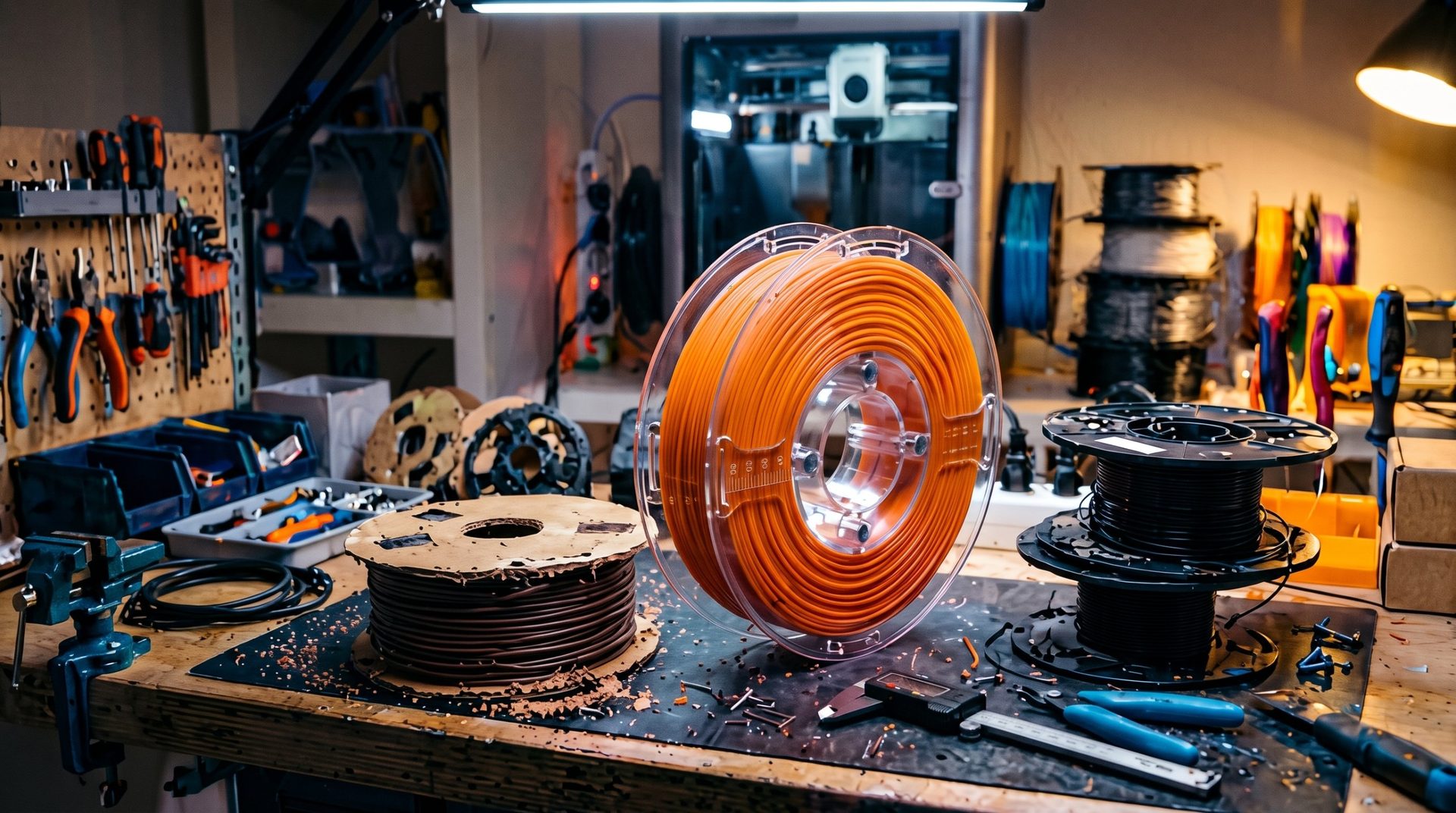
For years, every kilogram of filament printed left behind a bulky waste product: a rigid plastic spool weighing 200 to 250 grams. For a maker consuming 30 spools per year, that's over 6 kg of disposable plastic—rarely accepted by recycling programs because these spools mix various, often unmarked plastics (polystyrene, polycarbonate, polypropylene…).
Facing the buildup of these "corpses" in workshops, manufacturers fought back. On one side, refills without spools (refills), mounted on a reusable spool (MasterSpool), offered notably by Bambu Lab or Fiberlogy. On the other, the shift to recyclable cardboard spools, adopted by brands like Polymaker, Overture, or eSUN.
On paper, the ecological transition seemed obvious. But facing motorized multi-material systems (Bambu Lab AMS, Anycubic ACE Pro, Creality CFS), enthusiasm quickly faded.
1. The Cardboard Paradox in Multi-Material Systems
On a standard filament feeder, a cardboard spool works fine. But in closed enclosures where spools rest directly on motorized rollers, cardboard reveals three weaknesses:
- Dust: with friction and repeated color changes, the cardboard edges fray. This dust seeps into the mechanism, clogs bearings, and ends up on rubber rollers, which slip.
- Warped spools: unlike molded plastic, cardboard deforms with humidity or transport impacts. A warped spool rubs against the cover or jumps off its rollers during rapid retractions.
- End of spool: cardboard spools are lighter. When only 100 to 150 g of filament remains, they lack enough weight to stay pressed on the rollers—they jump and jam the feeder.
2. Workshop Solutions: Adapter Rings or Refills?
To balance zero waste and reliability, two approaches clash:
| Solution | Advantages | Disadvantages | Verdict |
|---|---|---|---|
| Clip-on spool rings | Allow using any cardboard spool, with no extra cost. | Consume filament to print (about 30 to 35 g per pair); can widen the spool, causing friction on walls; can slip on cardboard. | Quick fix for clearing cardboard spool stock. |
| Refills on MasterSpool | Rigid and perfectly round spool, zero parasitic friction, no dust. Reusable indefinitely. | Tricky assembly at first (risk of tangling if you cut fasteners too early); limited choice from some vendors yet. | Best solution for reliability and longevity. |
3. Real Environmental Impact: Is It Actually Eco-Friendly?
- Standard plastic spool: about 230 g of single-use plastic per 1 kg of filament—nearly a quarter of the filament's weight.
- Cardboard spool: no plastic at purchase, but you often print two protective rings (about 35 g of PLA or PETG) or reinforce edges with cloth tape. These rings are reused from spool to spool.
- Refill on MasterSpool: the small central cardboard core weighs under 25 g. Once you buy or print the MasterSpool, waste drops to under 2.5% of total weight.
4. Best Practices for Successful Refills
- Never cut fasteners before locking everything: slide the refill onto the first half of the MasterSpool, align the notch, screw or clip the second half, then cut the zip ties. Otherwise, filament unwinds suddenly and tangles.
- Print your MasterSpools in heat-resistant material: if your spools go into a desiccant dryer at 55–65 °C, often needed for drying filament in PETG or TPU, avoid PLA—it would warp and jam the filament. Choose PETG, ABS, or ASA instead.
- Weight light cores properly: for end-of-spool in multi-material systems, some makers print a small central reservoir filled with steel balls or desiccant to keep enough weight on the rollers.
What Filament Should You Load on Your Spools?
Cardboard spool, refill, or MasterSpool: the carrier matters, but the material determines your print success. PLA, PETG, TPU, ASA, or nylon: our finder compares 12 filaments by your needs (heat, outdoor use, flexibility, strength…), with recommended nozzle and bed temperatures.