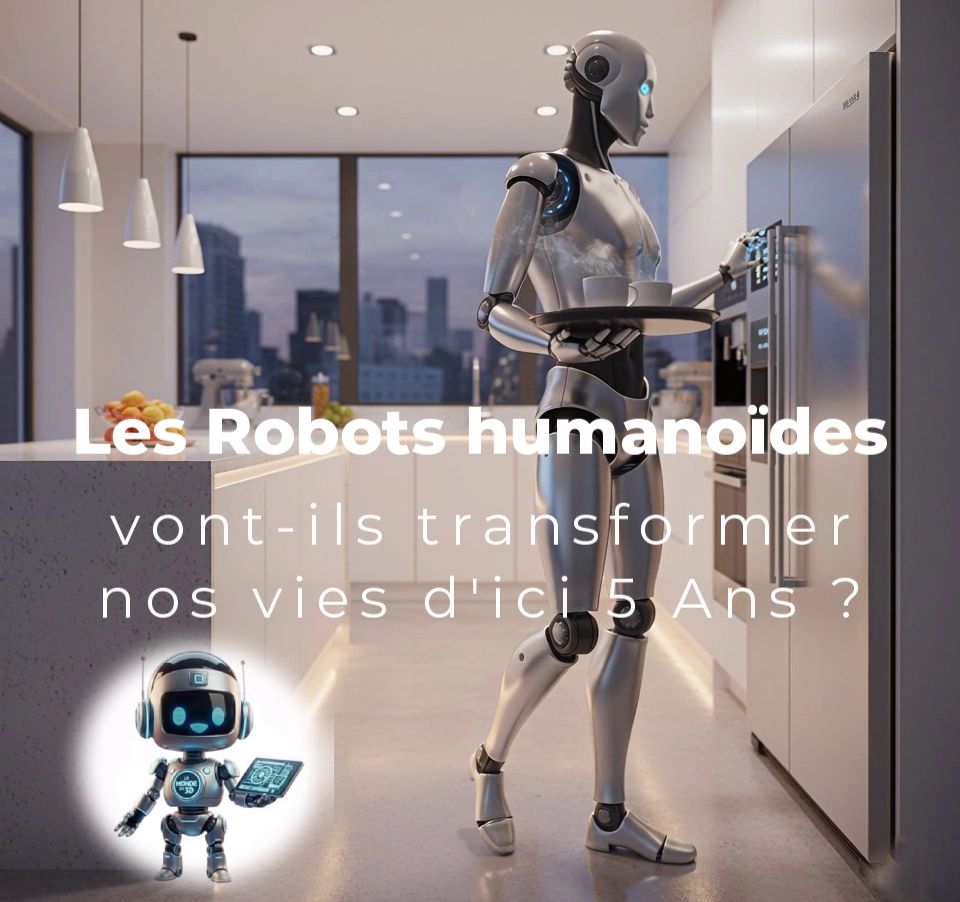
🤖 ⚠ Are Robots Dangerous?

The idea that robots could pose a threat has captivated our collective imagination for decades, from science fiction films to warnings from major technologists. Yet the reality is more nuanced: "danger" depends less on the machine itself than on how we use and program it.
Here's an analysis of the different types of risks associated with robotics today.
✅ Physical and Industrial Risks
This is the most immediate and concrete threat. In factories, robots are powerful metal masses capable of rapid movements.
-
Workplace safety: Without appropriate sensors, a robot can injure a human in its path.
-
The solution (Cobotics): We are increasingly developing collaborative robots (cobots) equipped with pressure sensors that stop instantly at the slightest contact.
✅ The Risk of Autonomous Systems (AI)
The danger changes in nature when Artificial Intelligence is integrated. The robot no longer simply executes a task; it "decides."
-
Autonomous weapons: This is the point that most concerns the scientific community (like the Future of Life Institute). Robots capable of choosing and striking a target without human intervention pose major ethical and security problems.
-
Decision bugs: A delivery robot or autonomous vehicle may, faced with an unprecedented situation, make an unpredictable or dangerous decision.
✅ Socio-Economic Impact
Danger isn't always physical aggression; it can be systemic.
-
Job displacement: Massive automation risks making certain professions obsolete, creating social instability if the transition isn't managed.
-
Technological dependence: The more we delegate critical tasks to robots, the more vulnerable we become in case of widespread failure or cyberattack.
✅ The Safeguards: Why We're Not (Yet) in "Terminator"
To counter these risks, robot development relies on several safety pillars:
| Type of Protection | Description |
| Ethics | Asimov's "Laws of Robotics" are no longer fiction but inspire the EU's ethical charters (AI Act). |
| Cybersecurity | Protecting robots from hacking to prevent them from being diverted to malicious purposes. |
| Software Design | Use of "sandboxing" to test AI behaviors before deployment. |
The majority of accidents involving robots are due to human error or failure to follow safety protocols, not a "machine rebellion."
✅ Tips for Professional Results
Robots are not inherently dangerous; they are increasingly autonomous tools. The real challenge lies in governance: establishing strict rules on the use of autonomous weapons and ensuring that AI remains aligned with human values.
What do you think?
We've just seen that the boundary between technological progress and ethical risk is sometimes thin. The question is no longer whether robots will be part of our future, but what place we're willing to give them.
-
Are you more optimistic, convinced that technology will solve our greatest challenges (health, environment, dangerous work)?
-
Or are you worried about seeing our autonomy and security handed over to lines of code?
-
Would you trust a robot to watch your children, operate on you, or drive your car?
Share your thoughts in the comments! Your vision of the future is essential to understanding how we must build tomorrow's society.