How 3D Printing Builds Habitats on Mars and the Moon

Humanity's expansion beyond Earth faces a colossal logistical obstacle: transportation. Every kilogram of equipment sent into space costs tens of thousands of dollars. To establish permanent bases on the Moon or Mars, we must stop importing and start manufacturing on-site. 3D printing is the only technology capable of making this dream of space colonization affordable and realistic.

The Key Concept: In-Situ Resource Utilization (ISRU)
Shipping bricks, beams, or concrete from Earth is unthinkable. The solution from NASA and its partners is simple, yet revolutionary: use the soil beneath our feet as raw material. This is the principle of In-Situ Resource Utilization (ISRU).
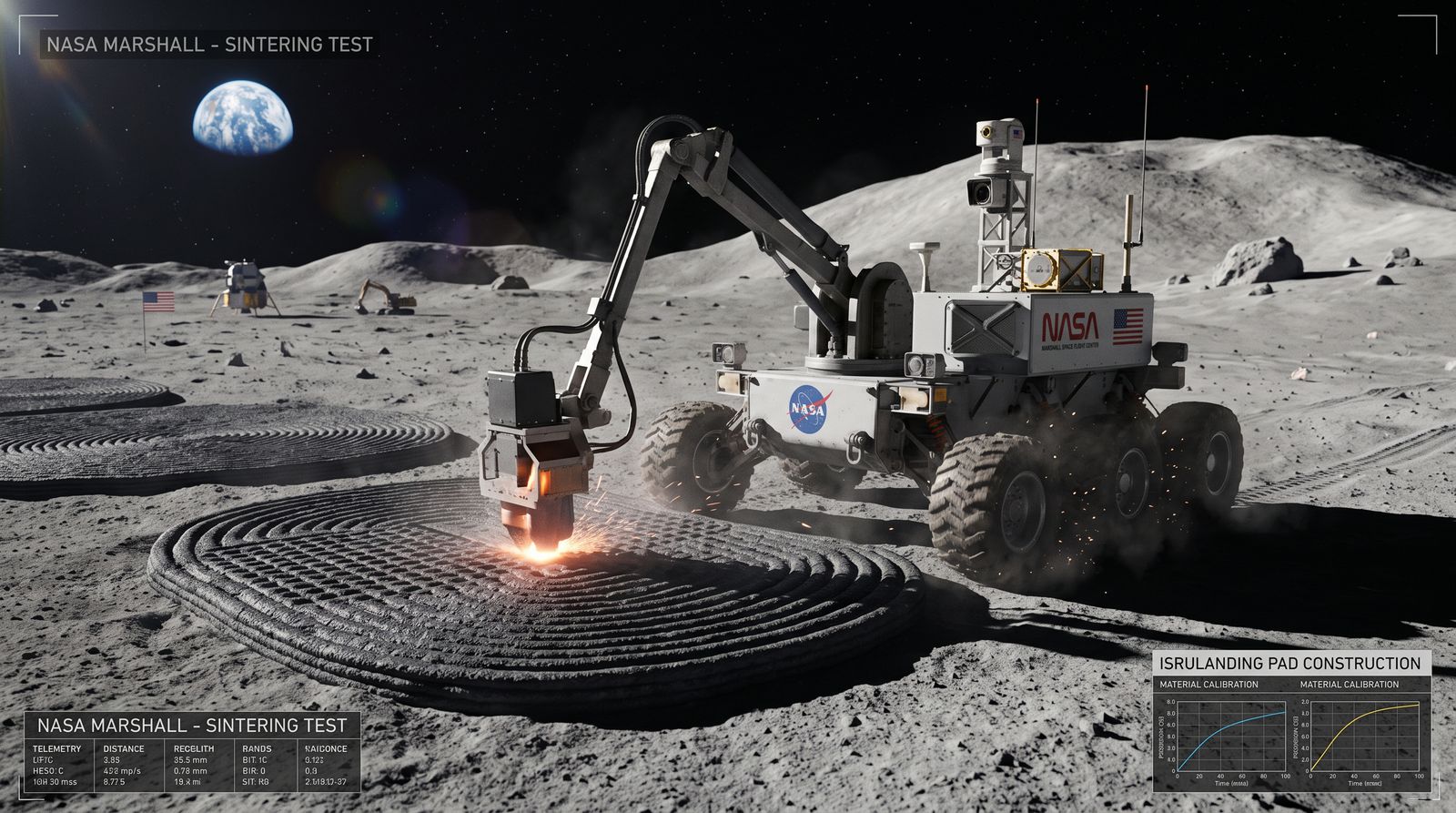
- Regolith as Raw Material: The lunar and Martian soil, called regolith, is a mixture of minerals and oxides. Researchers are actively developing binders and technologies capable of fusing or sintering this abrasive dust to create a building material.
- Giant Autonomous Printers: The idea isn't to send humans to build, but to deploy a robotic 3D printing system (often a massive gantry or robotic arm mounted on a rover) that will begin printing the habitat before astronauts arrive.
The Challenge of Printing in Extreme Environments
3D printing a home on Earth is already complex. Doing it on another planet adds extreme constraints that engineers must overcome:
- Protection Against Radiation: Unlike Earth, the Moon and Mars lack a powerful magnetic field. The habitat must therefore be thick to serve as a shield. 3D printing is perfect for building dense structures or for coating inflatable modules with protective layers of regolith.
- Vacuum and Low Gravity: On the Moon, the vacuum creates manufacturing challenges, and low gravity changes how material flows and deposits. Printing systems must be designed to function in completely different environmental conditions.
- Extreme Temperatures: Temperature swings (from −173°C to 120°C on the Moon) require extremely robust materials and printing processes.
NASA's Initiatives: Catalyst for Innovation
To accelerate research, NASA has often relied on public competitions. The most famous was the 3D-Printed Habitat Challenge, which encouraged companies and universities worldwide to design and 3D print models of space habitats.
- Design Validation: These competitions validated innovative designs, particularly dome and shell structures that better resist internal pressures and provide maximum protection with minimal material.
- The Key Objective: Develop systems capable of building a safe shelter autonomously and reliably. The priority is ensuring that once astronauts arrive, they already have a pressurized and insulated refuge waiting for them.
3D printing is therefore far more than just a manufacturing technique for NASA. It is the essential strategy for transforming the barren soil of other worlds into a home for humanity, marking the beginning of a new era of sustainable space exploration.