3D Printing for Unique Castle Decor
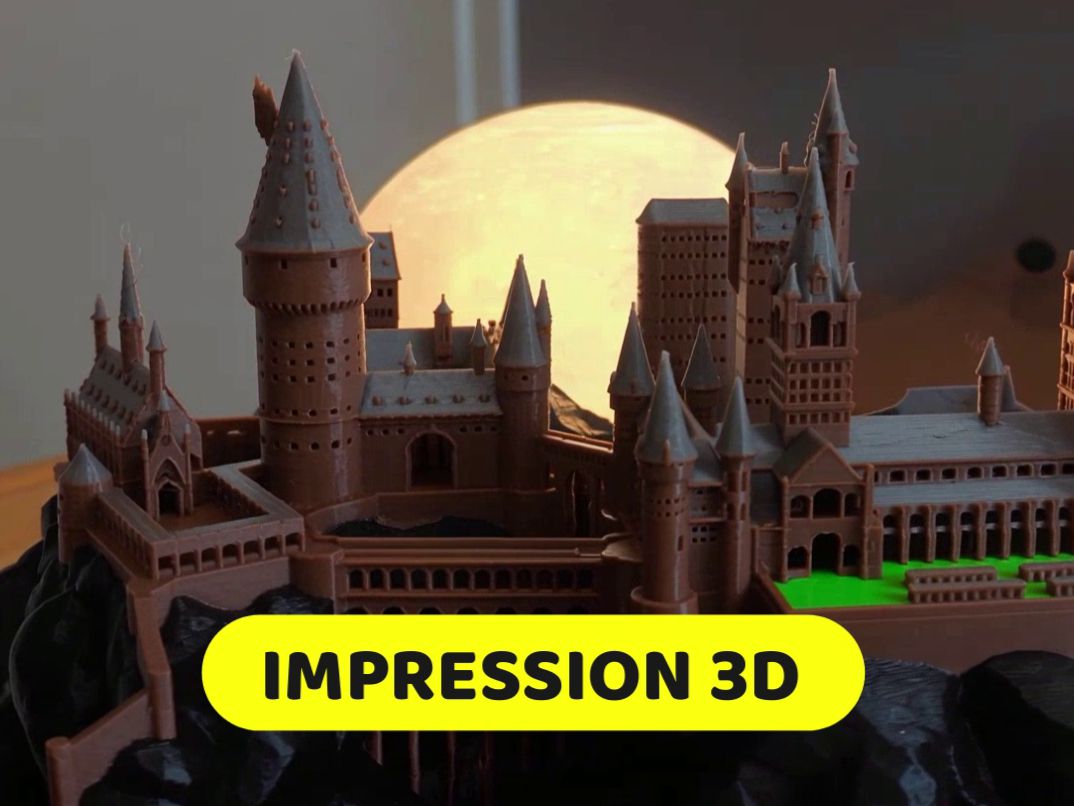
For tabletop RPG enthusiasts, wargamers, or collectors of medieval and fantasy miniatures, castle scenery isn't just a simple backdrop—it's a battlefield, a dungeon to explore, a stronghold to defend. 3D printing is the ultimate tool for creating modular, detailed, and immersive castle decor that you won't find in stores.

Why 3D Printing Is the Key to Fortifications
3D printing outperforms traditional miniature castle building kits:
- Perfect Scale: Whether your miniatures are 28 mm (classic tabletop RPGs like Dungeons & Dragons, Warhammer), 1/72 (historical scale modeling), or 32 mm (modern figurines), you can precisely adjust the size of every wall, tower, and battlement to match your games and collections perfectly.
- Architectural Detail: 3D printers (FDM for large elements, resin for fine details) can reproduce cut stone textures, arrow slits, dungeon graffiti, aged woodwork, and intricate metalwork with remarkable fidelity.
- Modularity and Customization: Say goodbye to rigid kits! 3D printing lets you create modular elements (straight walls, corner walls, towers, gates, removable roofs) that you can assemble and reassemble endlessly to build different castle or dungeon layouts for every session.
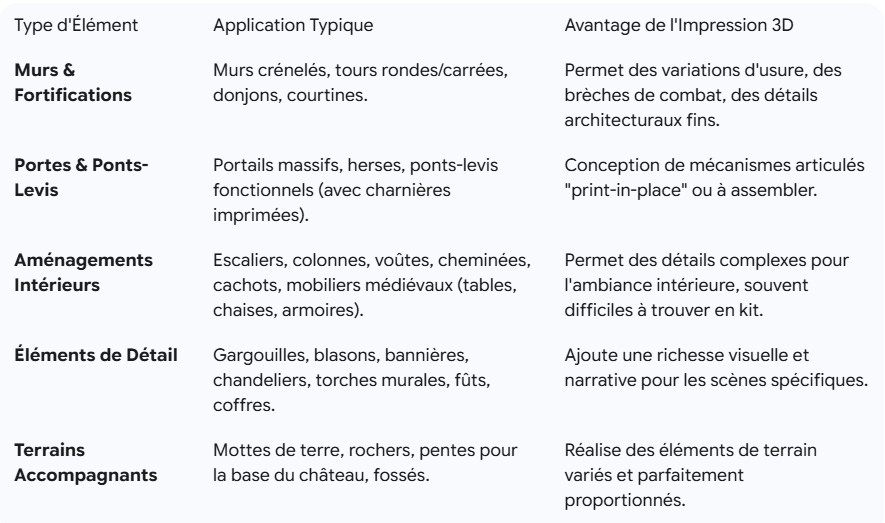
Key Elements of Castle Decor You Can 3D Print
3D printing opens an infinite range of possibilities to bring your fortresses to life:
Technical Tips for Realistic Fortifications
To transform filament or resin into a believable citadel, a few tricks are essential:
- Choosing Your Filament or Resin:
- FDM (Filament): Ideal for large structural elements (walls, towers). PLA is the most common choice. A layer height of $\mathbf{0.2 \text{ mm}}$ to $\mathbf{0.28 \text{ mm}}$ can enhance stone textures.
- SLA/DLP (Resin): Essential for tiny details (gargoyles, coats of arms, fine window grilles, statuettes, miniature furniture) that demand extreme precision.
- Texture and Weathering:
- After printing, don't hesitate to use a wire brush or sandpaper to simulate stone wear. Modeling putty can hide layer lines on smooth surfaces and create stucco effects.
- The drybrush technique after a black or gray primer coat is essential for bringing out every stone and crevice.
- Modularity and Assembly:
- Favor designs with connectors (clips, magnets, tenons) to make assembly and disassembly easy. This lets you create endless different layouts.
- For pieces that need to fit together, ensure your print tolerances are properly tuned to avoid parts being too tight or too loose.
By mastering 3D printing, you're no longer just buying a scenery piece—you become the architect of your own fortress, creating unlimited medieval and fantasy worlds for your miniatures.