What Do You Print Most? The Eternal Dilemma Between Useful, Figurine, Gift, and Professional
When you buy your first 3D printer, the instinct is almost always the same: you fire up a Benchy, a little articulated dragon, or a figurine found on MakerWorld or Printables. But after a few weeks and several spools, how does machine usage really change?
There's no official statistic, but trends from major 3D file platforms and community feedback paint a pretty clear picture. The percentages below are rough estimates, not exact figures.
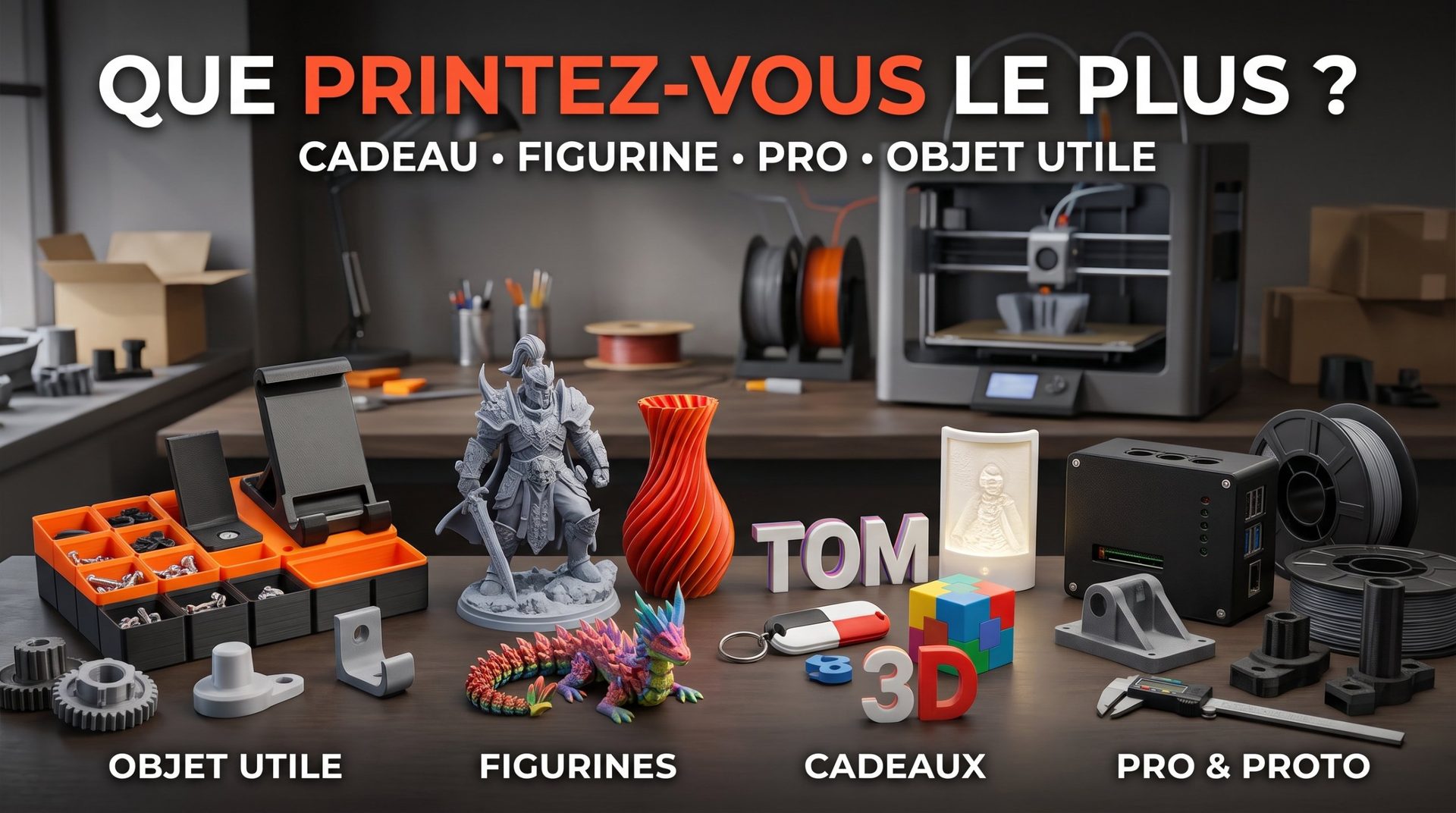
1. Useful Objects and Organization: The Big Winner (About 60%)
This is the top category, especially in FDM (fused deposition modeling). Your 3D printer becomes a genuine mini-factory for fixes and custom organization:
- Organization: Gridfinity bins, drawer dividers, wall-mounted tool racks, cable organizers under the desk.
- Repair and replacement: hard-to-find washing machine button, broken battery cover, cabinet hinge, shutter hook. Saving a 200€ appliance with 12 grams of PETG remains one of the greatest maker satisfactions.
- Printer upgrades: filament guide, purge bucket, LED lighting, spool holder.
2. Figurines and Decorative Objects (About 15 to 20%)
Very popular among pop culture fans, cosplayers, and board game enthusiasts:
- Tabletop RPG and wargame miniatures: Warhammer, D&D, dioramas. This category is mostly driven by resin printers, unbeatable for fine detail.
- Articulated and decorative figurines in FDM: with multi-color systems (Bambu Lab AMS, Anycubic ACE, Creality CFS), figurines come off the build plate with a finished look, no painting needed.
- Decoration: vases printed in vase mode, lithophanes, custom lamps and illuminated signs.
3. Personalized Gifts and Toys (About 10 to 15%)
As holidays or birthdays approach, the printer runs at full steam:
- Personalized objects: 3D letter names, two-color keychains, door plaques, lithophanes of a family photo.
- Toys and puzzles: 3D puzzles, flexible fidgets, printable board games.
This is the "wow factor" side, the one that often makes people accept a machine that's sometimes noisy in the living room. Need ideas? Our free 3D files are packed with keychains, cake toppers, and decor items to give as gifts.
4. Professional Use and Prototyping (About 10%)
For freelancers, engineering firms, craftspeople, or online shop creators:
- Jigs and tooling: drill guides, cutting templates, custom clamps for assembly.
- Electronic enclosures: custom housings for Raspberry Pi, ESP32 modules, home automation sensors, and functional prototypes.
- Small runs: objects sold online or technical parts in strong materials (ABS, ASA, carbon-filled nylon, TPU).
No suitable printer on hand or need a technical part? Our on-demand 3D printing service handles it.
Summary: How Does a Maker's Profile Evolve?
| Period | What Mostly Comes Off the Plate | Typical Filament |
|---|---|---|
| Month 1 (Discovery) | Calibration tests (Benchy, cubes), articulated gadgets, easy figurines | Standard PLA |
| Months 2 to 6 (Organization) | Desk organization, hooks, drawer bins, phone stands | PLA+, matte PLA |
| After 6 months (Mastery) | Custom repairs (measured with calipers), technical parts, jigs | PETG, TPU, technical filaments |
To pick the right material at each stage, our selector compares 12 filaments based on your needs:
What's running on your build plate right now? Team useful repair or team figurines and decor? Let us know in the comments!
🗳️ What's your #1 use for 3D printing this year?
Click your answer to vote and discover the results.