The Unitree Go2 Robot Dog: Deep Dive into Version 2
The Unitree Go2, launched by Unitree Robotics to succeed the renowned Go1, marks a major milestone in service robotics. By 2026, it has established itself not just as a technical feat, but as a versatile tool integrating generative artificial intelligence.
Here's everything you need to know about this robot that's redefining human-machine interaction.

✅ Revolutionary Perception: 4D Lidar
The biggest innovation of the Go2 lies in its vision system. While the Go1 relied on standard cameras, the Go2 comes standard with an ultra-wide angle 4D L1 Lidar (360° x 90°).
-
Zero blind spots: It detects obstacles as close as 5 cm away.
-
All-terrain navigation: It maps its environment in real time, even in complete darkness or facing complex surfaces (stairs, grillwork).
-
Enhanced precision: The ISS 2.0 tracking system allows the robot to stay alongside its user with 50% improved accuracy.
✅ Embodied Intelligence: GPT and Voice
The Go2 is no longer a "mute" robot. Thanks to the integration of language models (GPT-type), it becomes capable of:
-
Understanding complex commands: Instead of a simple voice command, you can tell it: "There's a lot of people here, stay very close to me".
-
Voice interaction: It can answer questions, describe what it sees through its HD camera, or even translate sentences.
-
Self-learning: The robot uses AI to optimize its gait based on terrain (sand, ice, grass) through massive cloud simulations.
✅ Performance and Battery Life
The Go2 has been thoroughly revised to be more enduring and robust:
-
Speed: It can run up to 18 km/h (5m/s) for the highest-performance versions.
-
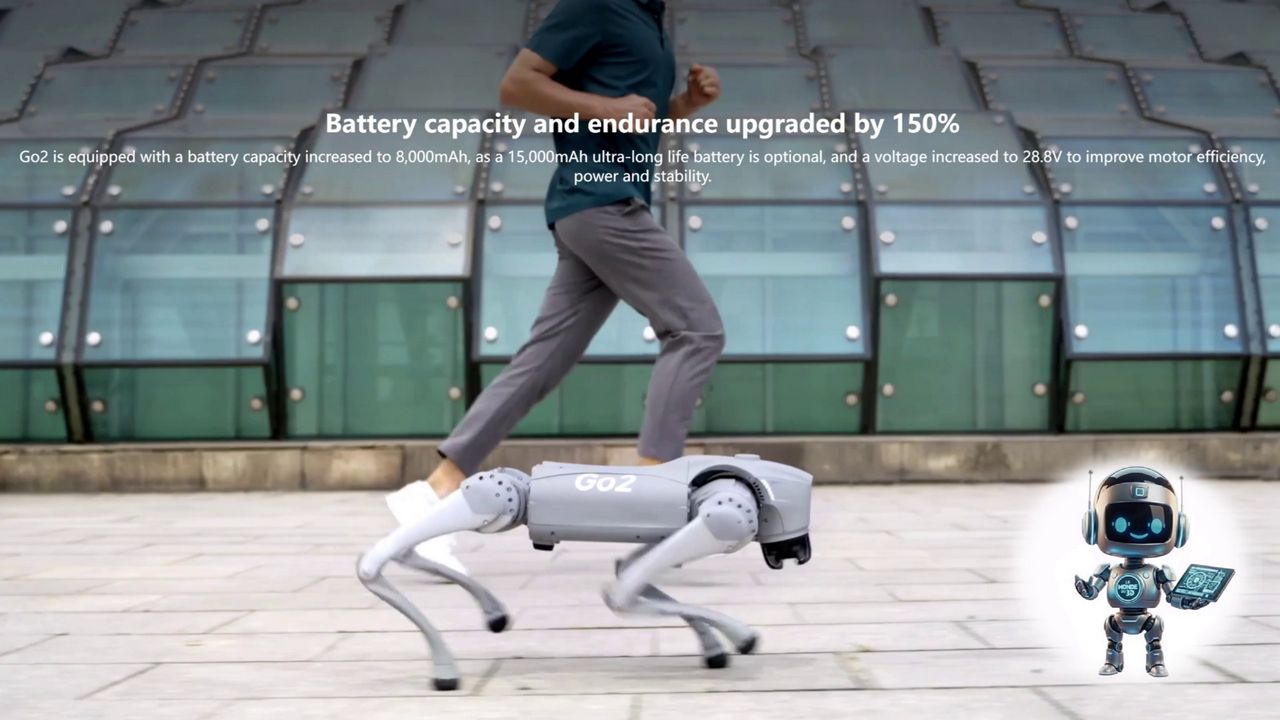
Endurance: Its battery can reach 8,000 mAh (Standard) or 15,000 mAh (Option), providing between 2 and 4 hours of continuous use.
-
Power: Joint motors deliver 45 N.m of torque, allowing it to carry loads up to 7-10 kg and perform acrobatics (backflips, two-legged walking).
✅ Range and Accessories: A Customizable Robot
In 2026, the Go2 lineup comes in multiple configurations for every need:
| Model | Primary Target | Propulsion | Key Features |
| Go2 Air | Individuals / Discovery | 4 legs (pads) | Lowest price, basic functions. |
| Go2 Pro | Tech Enthusiasts / Professionals | 4 legs (pads) | Advanced smart tracking, GPT, 4G. |
| Go2-W (Wheeled) | Logistics / Patrol | 4 motorized wheels | High speed, quiet operation and endurance. |
| Go2 EDU | Research / Universities | 4 legs (or wheels) | Full code access (SDK), high-precision Lidar. |
Top accessories:
-
Robotic arm (D1): A 6-degree-of-freedom arm for picking up objects or opening doors.
-
Charging dock: So the robot can return to charge its batteries autonomously, like a robot vacuum.
-
Specialized sensors: Ability to add thermal cameras or gas detectors for industrial inspection.
✅ Focus on the Go2-W: The Wheeled Robot
The Go2-W version is a hybrid evolution. At the end of its four legs, the rubber feet are replaced by 7-inch motorized wheels.
Why choose the wheeled version?
-
Energy Efficiency: On flat surfaces (warehouses, asphalt, offices), rolling consumes far less energy than walking. Battery life is significantly extended.
-
Top speed: The Go2-W can reach higher speeds and maintain a constant pace without the natural oscillation of a running gait.
-
Sensor stability: For 3D mapping or video surveillance, wheels provide much more stable footage than the jerks of a legged robot.
-
Hybrid versatility: It can still bend its legs to climb a step or crouch, combining the agility of a quadruped with the speed of a traditional mobile robot.
Go2-W Limitations
The main drawback is reduced traction on very loose terrain (deep sand) or heavily uneven surfaces where the standard articulated foot remains superior for "gripping" the relief.
The Go2-W version is particularly popular for "last-mile" deliveries in urban areas and for silent nighttime surveillance of large industrial sites.
The Go2 is no longer just a toy for engineers. With a starting price around $1,600 (before taxes), it makes autonomous robotics accessible to SMEs for surveillance, or even to individuals as a technological assistant.