Unitree Go1: The Quadruped Robot That Democratized Robotics
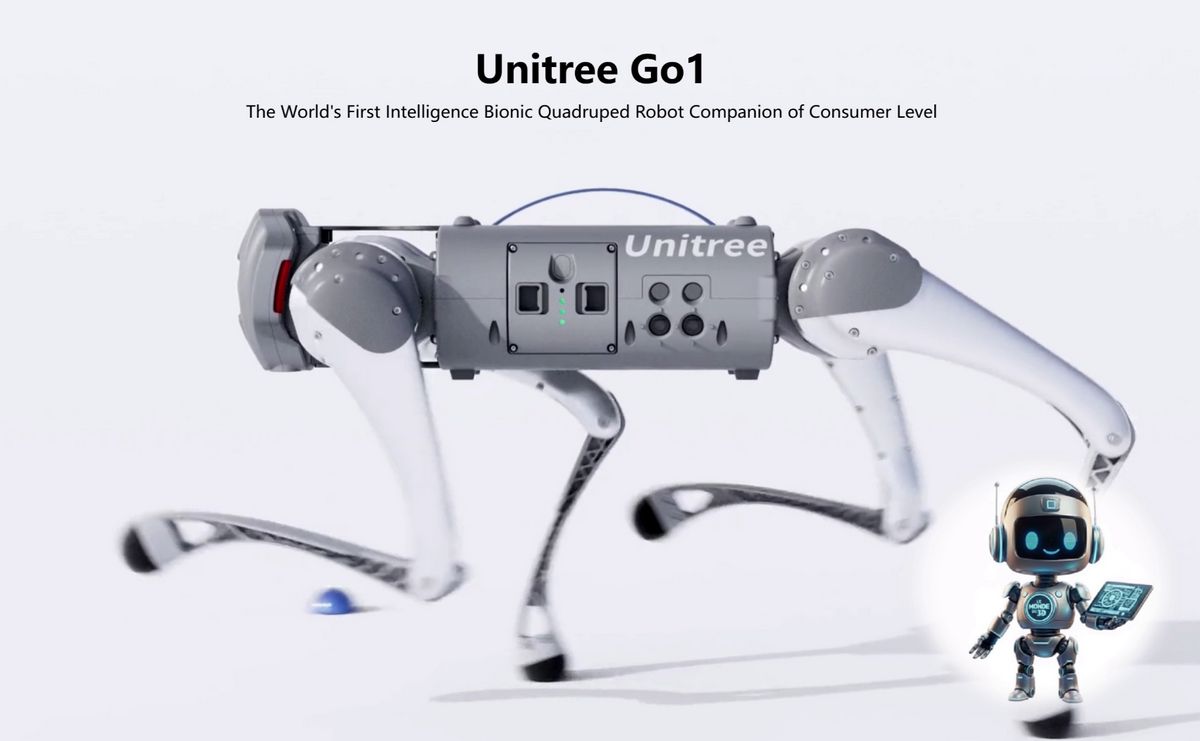
While Boston Dynamics captured the world's imagination with Spot, Chinese company Unitree Robotics disrupted the market with the Go1. Its winning formula? Deliver an agile, intelligent quadruped robot capable of following a human—for a fraction of its competitors' prices.

✅ Technical Specifications and Performance
The Go1 is far more than a gadget; it's a powerhouse of computing and mechanical engineering.
-
Speed and Agility: The "Pro" version can reach speeds of 17 km/h (roughly 4.7 m/s), making it one of the fastest robots in its category.
-
SSS System (Super Sensing System): Equipped with 5 wide-angle fisheye cameras and ultrasonic sensors, it delivers 360° vision and real-time obstacle avoidance.
-
Artificial Intelligence: Powered by high-performance processors (up to 16 AI cores depending on the model), it instantly processes visual data to recognize its owner.
-
Lightweight: At approximately 12 kg, it's easily transportable in a dedicated backpack.
✅ The "Side-Follow" Tracking System: A Key Innovation
Unlike many robots that follow a person from behind, the Go1 uses lateral tracking technology.
-
Advantage: The robot stays in the user's field of vision. It's far more natural and secure in complex environments (crowds, sidewalks).
-
Interaction: It doesn't need GPS or complex remote controls; it uses computer vision to "lock" onto its human target.
✅ What's It Used For?
The Unitree Go1 comes in three versions (Air, Pro, and Edu), each targeting different needs:
-
Education and Research (Edu Version): Its true calling. Thanks to its open API and ROS (Robot Operating System) support, universities use it to develop AI algorithms, gait optimization, and mapping technologies.
-
Inspection and Surveillance: Its ability to traverse rough terrain (stairs, grass, rocks) makes it perfect for patrolling industrial sites and hard-to-reach areas.
-
Leisure and Lifestyle: For tech enthusiasts, it becomes a jogging companion or small-load transporter.
-
Last-Mile Delivery: Tests are underway to use it as a lightweight package carrier in urban settings.
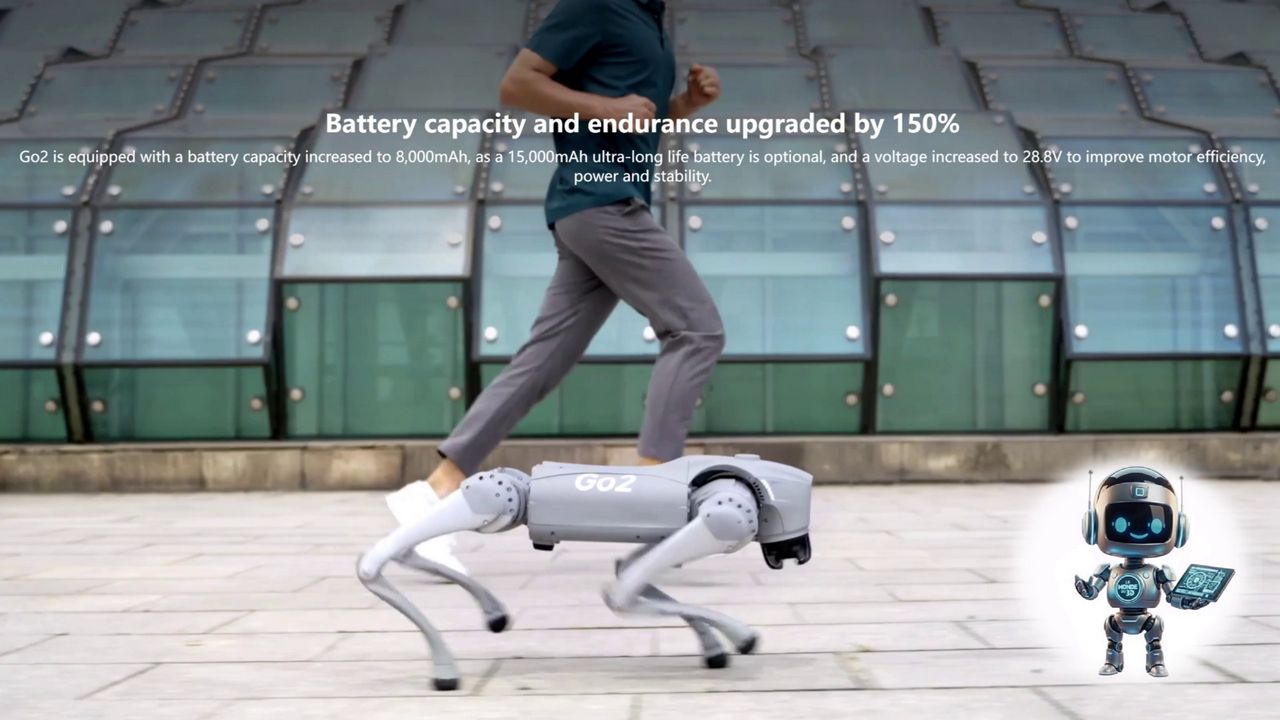
By 2026, while the Go1 remains iconic, it's been joined by its successor, the Unitree Go2, which now integrates generative AI (GPT-style) for voice interaction and even greater autonomy.
| Feature | Unitree Go1 (The Original) | Unitree Go2 (Next Generation) |
| Primary Sensor | Fisheye Cameras (2D/3D Vision) | Ultra-Wide 4D Lidar (360°x90°) |
| Max Speed | ~17 km/h (Pro Version) | ~18 km/h (Pro Version) |
| Runtime | 1h to 1.5h | 2h to 4h (High-Capacity Battery) |
| Intelligence | Basic Tracking AI | Integrated GPT (Voice Understanding) |
| Connectivity | Wi-Fi / Bluetooth | 4G / Wi-Fi 6 / Bluetooth |
| Load Capacity | Approx. 3–5 kg | Approx. 7–8 kg |
✅ The 3 Major Upgrades in the Go2
1. 4D Lidar: Revolutionary Vision
The Go1 relied primarily on cameras. The Go2 features Unitree's proprietary 4D Lidar.
-
Why it's better: Unlike cameras, Lidar isn't light-dependent. The Go2 navigates complete darkness, maps rooms with millimeter precision, and avoids tiny obstacles a Go1 would miss.
2. Generative AI Integration (GPT)
This is the most impressive change. With its integrated Large Language Model:
-
Natural Interaction: You can tell it: "It's going to rain, go home," and the robot understands the intent rather than waiting for a coded command like "Go Home."
-
Personality: The robot can simulate emotions or answer complex questions through its built-in speaker.
3. Mechanics and Movement
The Go2 got upgraded motors (actuators):
-
Power: Torque increased by 30%, enabling higher jumps, stable backflips, and better handling on slippery or soft terrain (sand, mud).
-
Tracking System: The "Side-Follow" system became ISS 2.0, far more stable. The robot almost never loses its owner, even in dense crowds.
✅ Which Should You Choose in 2026?
-
Go for the Go1 if: You're budget-conscious and want a development platform to learn robotics basics or handle simple events. Today it's an excellent used or entry-level option.
-
Go for the Go2 if: You need real autonomy. For industrial inspection, security, or advanced AI research, the Go2's 4D Lidar and doubled runtime make it substantially superior.
Did you know? The Go2 can now be piloted remotely via 4G, meaning you can control your robot in Paris while you're in Lyon.