The Invention of 3D Printing: The Story of the SLA-1, the First 3D Printer
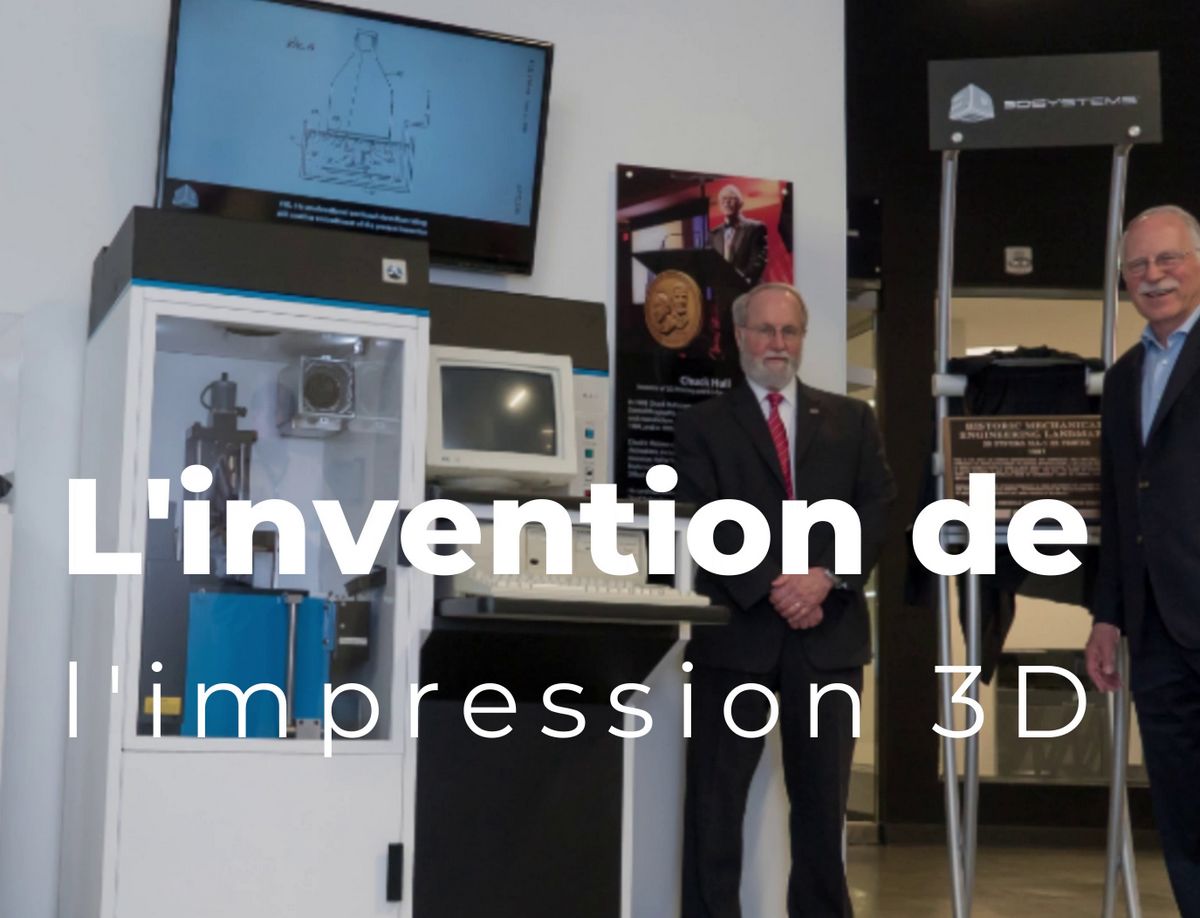
3D printing is often perceived as a recent technology from the 21st century. Yet its history began several decades ago, in an American laboratory, driven by a visionary engineer who laid the foundation for what would become a global technological revolution.

The Pioneer: Stereolithography in the 1980s
The invention of 3D printing is officially credited to Charles "Chuck" Hull. In 1984, this American engineer, who was working on UV coatings for furniture at the time, had the idea of using ultraviolet light to solidify photosensitive resins, layer by layer. It was no longer about drawing on a surface, but about building a three-dimensional object.
In 1986, Chuck Hull filed a patent for his invention, which he named "Apparatus for Production of Three-Dimensional Objects by Stereolithography". This process, known today by the acronym SLA (Stereolithography Apparatus), is the very first 3D printing method.
The Birth of 3D Systems and the First Commercial 3D Printer
Shortly after, in 1986, Charles Hull co-founded the company 3D Systems. Within this company, he developed the first commercial prototype of a 3D printer: the SLA-1.
The SLA-1 was an imposing and expensive machine designed for industry. Its goal was not to manufacture objects for the general public, but to revolutionize rapid prototyping. Companies could now create physical models of their parts in hours or days, a process that previously took weeks or months using traditional manufacturing methods.
The Evolution of Technology
Chuck Hull's invention paved the way for other technologies. In the late 1980s, Scott Crump invented FDM (Fused Deposition Modeling), the technology used by most desktop 3D printers today (molten filament deposition). He later founded the company Stratasys.
For decades, 3D printing remained an industrial tool, protected by patents. It was the gradual expiration of these patents in the 2000s and 2010s that enabled the emergence of open-source movements like the RepRap project, making the technology accessible to everyone and leading to the era of 3D printers we know today.
In conclusion, while the democratization of 3D printing is a recent story, it all began with Charles Hull's vision and his very first machine, the SLA-1, which laid the first stone of a manufacturing revolution.