Why 3D Printer Filament Spool Prices Are Rising on July 1

As July 1st approaches, panic is spreading through maker communities worldwide. The rumors were true: the €8 PLA spool imported from China, delivered to your mailbox without questions, is living its final hours. But reducing this price surge to a simple "European customs tax" would be a misjudgment. Our passion has found itself trapped at the crossroads of three global crises.
Here's the anatomy of this price explosion, and your survival guide to keep heating those nozzles without emptying your wallet.
✅ The European Trap: The July 1st Rule
July 1st marks the end of fiscal innocence for Asian e-commerce. The European Union permanently eliminates the customs duty exemption for small parcels worth less than €150 and introduces a flat tax of €3 per product category (the HS tariff code).
The trap lies in the calculation method: customs doesn't tax the box, it taxes families of objects.
-
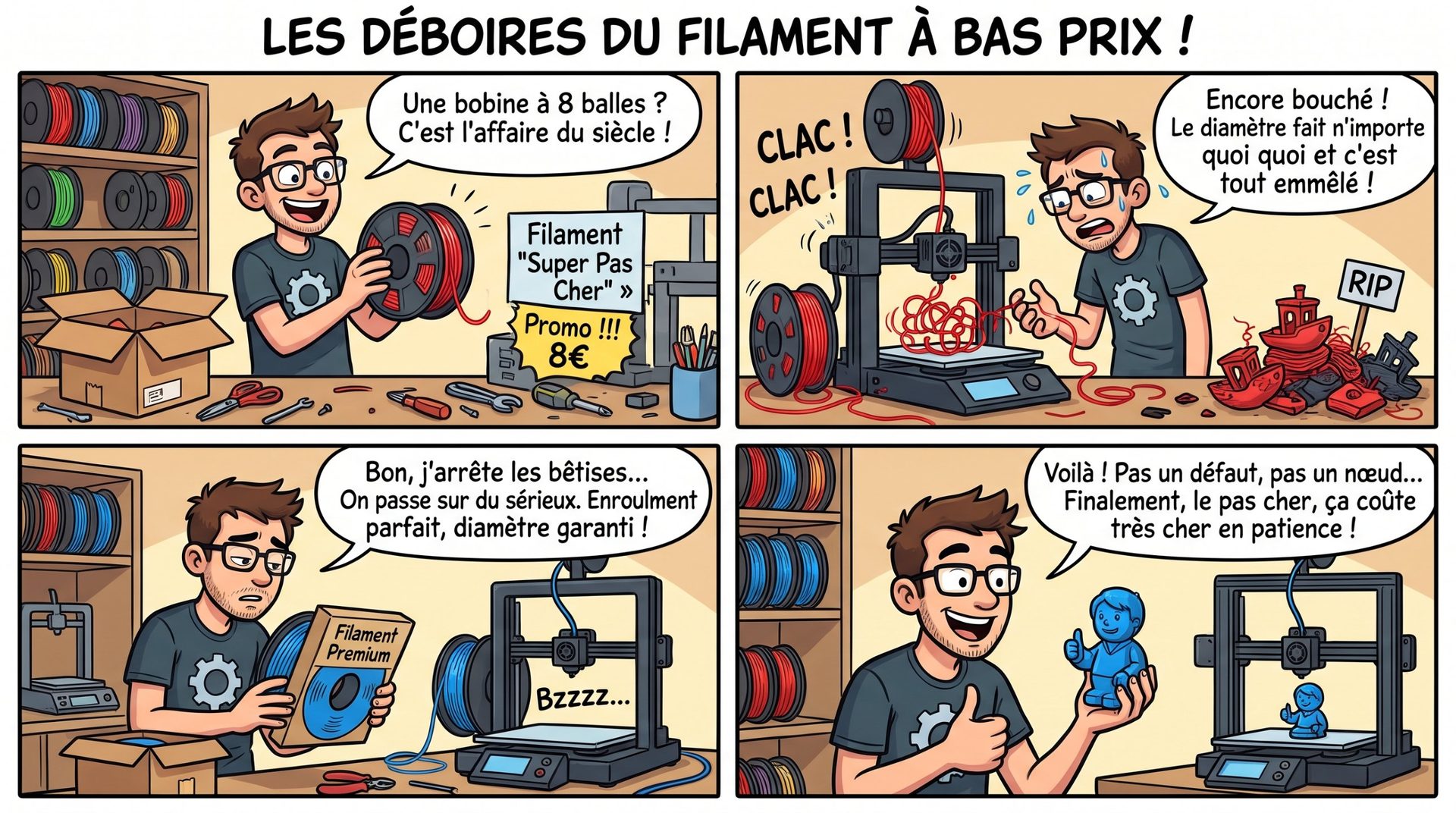
The "Suicide Basket": You order a single discounted PETG spool for €10 on AliExpress. Upon arrival, the equation reads: €10 + 20% VAT + €3 customs = €15 (a +50% increase).
-
The "Death Basket": You slip 1 spool (category plastics) + 1 steel nozzle (category metals) + 1 sensor (category electronics) into the same box. Customs identifies three distinct families. Your basket gets hit with €9 in flat taxes alone, before the first cent of VAT is calculated.
✅ The Domino Effect from the American Front
If Brussels is tightening the screws, it's also a ricochet effect. The United States struck first by dynamiting its own customs exemption (the $800 de minimis) and applying surcharges up to +60% on Chinese resins.
Facing this American tariff wall, the massive flow of cheap plastic first diverted toward Europe, saturating our logistics platforms before the EU retaliated. To survive, filament giants (Sunlu, eSUN, Creality) had to urgently reinvest millions: relocating factories to Vietnam, opening production lines in Mexico, and leasing massive storage warehouses across Europe. This colossal infrastructure cost is now being passed on to wholesale prices.
✅ The Shadow of War: Oil and Megawatts
We forget about it when the machine deposits its layers in a little hypnotic hum: a filament spool is a concentrated dose of heavy geopolitics.
-
Raw Material (40 to 60% of a spool's price): Whether PETG (petroleum) or PLA (processed cornstarch), the base pellet prices are indexed to energy. Middle East tensions and the Ukraine war send shipping routes and barrel prices into a spin. When a container ship's freight doubles, the price of plastic filament follows.
-
Processing: Transforming raw pellets into a perfect 1.75 mm filament is an energy pit. You must run giant drying ovens for hours, then keep industrial extrusion screws at 220°C continuously. The explosion in European electricity and gas costs has devastated margins for Western factories in recent years, preventing them from matching Asia's prices.
✅ The Maker's Survival Guide: The 4 Commandments
The end of the cheap Chinese spool isn't the death of 3D printing; it's the end of a market anomaly. To survive starting this month, you must rethink your buying strategy:
-
I. In Bulk Thou Shalt Buy. Since the €3 tax applies per category, if you order a pack of 10 spools at once from China, the €3 divides among them: the tax costs you just €0.30 per spool. Single-spool purchases are forbidden.
-
II. Thy Baskets Thou Shalt Purify. Never mix tools, fasteners, or electronics with filament spools in an order outside the EU again. Place two separate orders.
-
III. "EU Stock" Mentions Thou Shalt Hunt. Carefully check the line "Shipped from: France / Germany / Poland" on marketplaces. Containers that arrived by cargo ships have already been cleared by the brand upstream.
-
IV. "Made in France" Thou Shalt Rediscover. This crisis's great paradox: with Asian taxes getting heavier, the price gap with local manufacturers (Arianeplast, Francofil, Capifil...) has shrunk to nearly nothing. Paying €18 for a French PLA spool instead of an obscure imported brand taxed at €16, with a carbon footprint cut by ten and customer service in your language: the math checks out fast.

To find the ideal material for your project, try our filament selector.