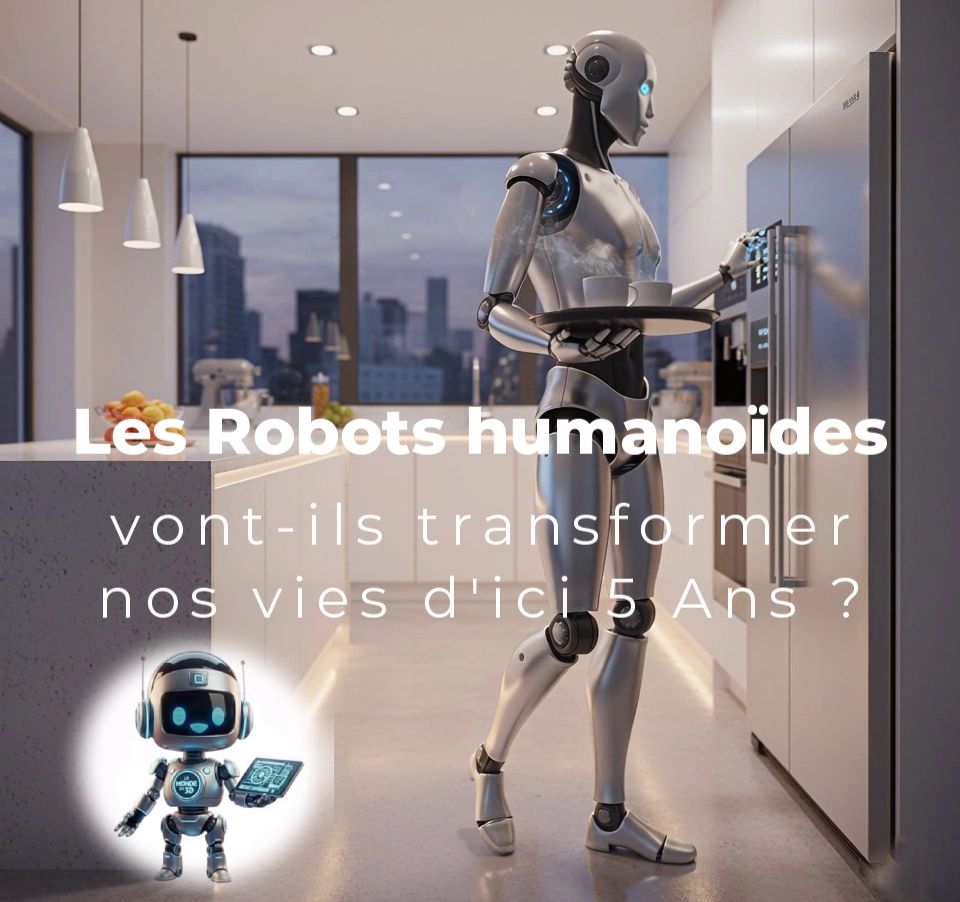
🤖 2026: The Arrival of Humanoid Robots

The year 2026 will not go down in history as just another technological milestone, but as the true tipping point toward a new era of civilization. For over a decade, the general public has watched, caught between fascination and skepticism, viral videos from labs like Boston Dynamics or Tesla showing machines still unsteady, capable of a few steps or choreographed backflips. These images, often perceived as distant laboratory feats, have given way to a brutal and fascinating reality: humanoids entering our everyday lives.
After a maturation phase accelerated by the explosion of generative AI in 2023 and 2024, we are definitively leaving the age of demonstration prototypes. In 2026, the convergence between the digital "brain" (large language models) and the mechanical "body" (robotics engineering) has reached its critical point. We are now witnessing the opening of the floodgates for commercialization and large-scale deployment.
If 2024 was the year of technical demonstrations and 2025 the year of industrial pilots, 2026 is officially designated by analysts (such as TrendForce) as the year of the "commercial inflection." An estimated 50,000 units are expected to be delivered worldwide that year, marking growth of over 700%.

✅ The Giants Go on the Offensive
Several major players have set 2026 as the deadline for their first external deliveries or mass production:
-
Tesla (Optimus): After intensive internal testing in its factories in 2025, Elon Musk plans to begin commercial sales of Optimus in 2026. The goal? Perform simple, repetitive tasks for third-party customers.
-
1X Technologies (NEO): The OpenAI-backed startup plans the first home deliveries of its NEO Beta robot in 2026. Unlike rigid industrial models, NEO is designed with soft "muscles" to interact safely with humans.
-
XPeng Robotics (Iron): The Chinese electric giant plans mass production of its "Iron" humanoid robot in 2026, with advanced integration already underway in its own assembly lines and showrooms.
-
Figure AI & Agility Robotics: Their respective robots, Figure 02 and Digit, should move from testing stages at BMW or Amazon to become standardized logistics solutions.
✅ From Factory to Living Room: The Two Faces of 2026
The arrival of these robots will not be uniform. Two fronts emerge:
The Industrial Front (Logistics and Manufacturing)
This is where the revolution will be most visible. Humanoid robots will replace forklifts and fixed arms for complex manipulation tasks:
-
Container unloading.
-
Sorting body parts (already tested by BMW).
-
Inspection of hazardous sites.
The Domestic Front (Personal Assistance)
Though more complex, 2026 will see the arrival of the first domestic "early adopters." These won't yet be all-purpose robots, but machines specialized in:
-
Object organization.
-
Surface cleaning.
-
Light assistance for the elderly (carrying loads).
✅ Remaining Challenges: Price and Safety
Despite the enthusiasm, two barriers remain for mass adoption:
-
Cost: While Tesla aims for a long-term price of $20,000, early 2026 models could still cost between €30,000 and €100,000, depending on complexity.
-
"Physical" AI: The challenge is no longer just talking (like ChatGPT), but understanding the physics of the real world (not breaking a glass when grasping it).
Did you know? In 2026, China hopes to already flood the market with "low-cost" models to force rapid adoption, while the United States is betting on cutting-edge AI and total autonomy.
The arrival of humanoids in 2026 marks the end of a science-fiction fantasy and the beginning of an industrial and social reality. While total human replacement is not on the agenda, automating tedious tasks and reducing workplace strain are now within reach. We are no longer anticipating: the revolution is underway, and it walks on two legs.
History will likely record that 2026 was the year the machine stopped being a static tool and became a mobile partner. One question then remains, no longer technical but personal: will the comfort of delegating your chores outweigh the strangeness of sharing your living room with a machine?
👉 Are you ready to welcome a robot into your home?