Studprint: Student Adam Turaj Builds a 3D Printer from 92% LEGO Bricks!
If there’s one community that loves pushing the limits of DIY, it’s the 3D printing community. But Adam Turaj, a Canadian mechatronics engineering student at the University of Waterloo, has just raised the bar for originality and ingenuity.
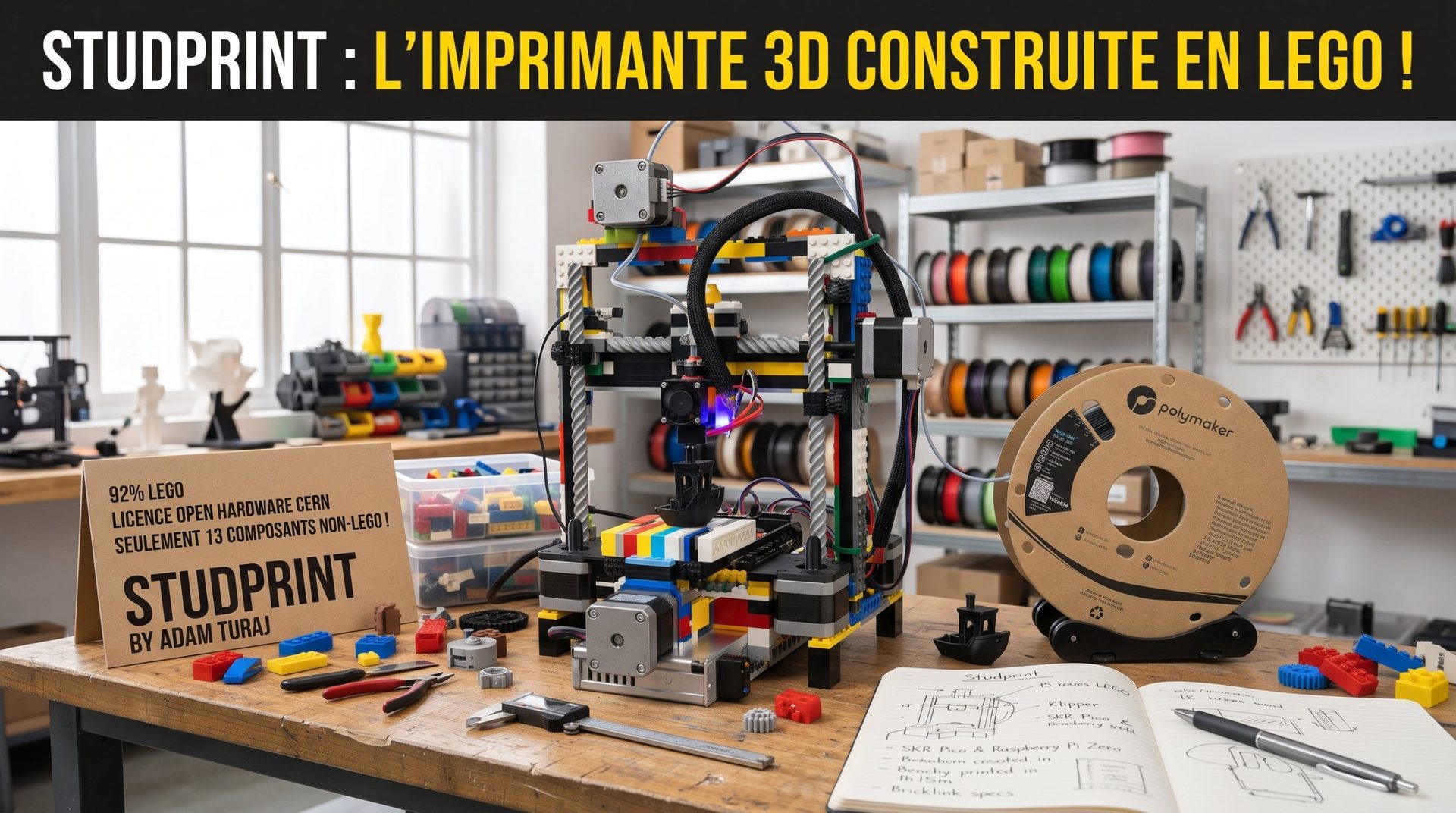
For Hack Club’s “Infill” challenge (build an original 3D printer for under $350), he took on a crazy bet: design a working 3D printer almost entirely from the bricks of our childhood. The result? Studprint, a machine whose frame, motion system and even extruder are made of 92% LEGO parts.
1. A rigidity and precision challenge in plastic
The hardest part when you build your own 3D printer is getting a perfectly rigid structure to avoid vibrations, which ruin the precision of filament deposition. With snap-together bricks, the challenge was huge.
To pull it off, Adam Turaj used plenty of tricks:
- A reinforced frame: classic bricks, including red 2×4 and 2×6 ones, stabilise the axes. Over his tests, he added reinforcements and long plates under the machine to reduce play.
- A 100% LEGO motion system: 15 LEGO wheels guide the axes and 11 Technic worm gears act as lead screws to move them.
- Bedslinger kinematics (moving bed), the simplest architecture for this kind of experiment.
Note: the 92% is counted by number of parts, not by weight. The motors and electronics weigh far more than their share of the list.
2. The parts that aren’t LEGO
Of course, you can’t do everything in LEGO. To make the machine move and heat up, the student added standard 3D printer components:
- a BigTreeTech SKR Pico V1.0 control board and a Raspberry Pi Zero 2 W running the Klipper firmware;
- a Mean Well 24 V power supply;
- five NEMA 17 stepper motors;
- a BLTouch sensor to compensate for an uneven plastic bed;
- a hotend to melt and lay down the filament;
- BMG-style extruder gears with a spring tensioner: the LEGO wheels didn’t grip enough to push the filament without slipping.
A few small 3D-printed parts also serve as mounts for the motors and electronics. The total cost is estimated at about $197, including around $60 of LEGO, excluding tax and shipping.
The result? Studprint passed its first big test by printing the famous benchmark boat, the 3DBenchy, in about 1 h 15 min. Quite a feat given the starting materials!
3. A fully open-source project to copy at home
True to the sharing spirit of the open-source world, Adam Turaj has published all his work under the CERN Open Hardware (CERN-OHL-S-2.0) licence.
The full documentation is freely available on GitHub and his personal website. You’ll find:
- the CAD files to understand the assembly;
- the parts list, with LEGO references using BrickLink numbering;
- the detailed build log of his 59 hours of work, with every problem he ran into (axis play, extruder, filament kinking in the tube) and how he solved it.
Now all you have to do is clone it!
Since the project is open and the plans are available, building your own 3D printer from an old tub of LEGO is now possible. Don’t expect the precision of a commercial machine, but it’s a fantastic project for learning how a 3D printer works. And to close the loop, why not use your Studprint to print… new compatible bricks to build other machines?