The Story of Bambu Lab: How Former DJI Engineers Revolutionised 3D Printing
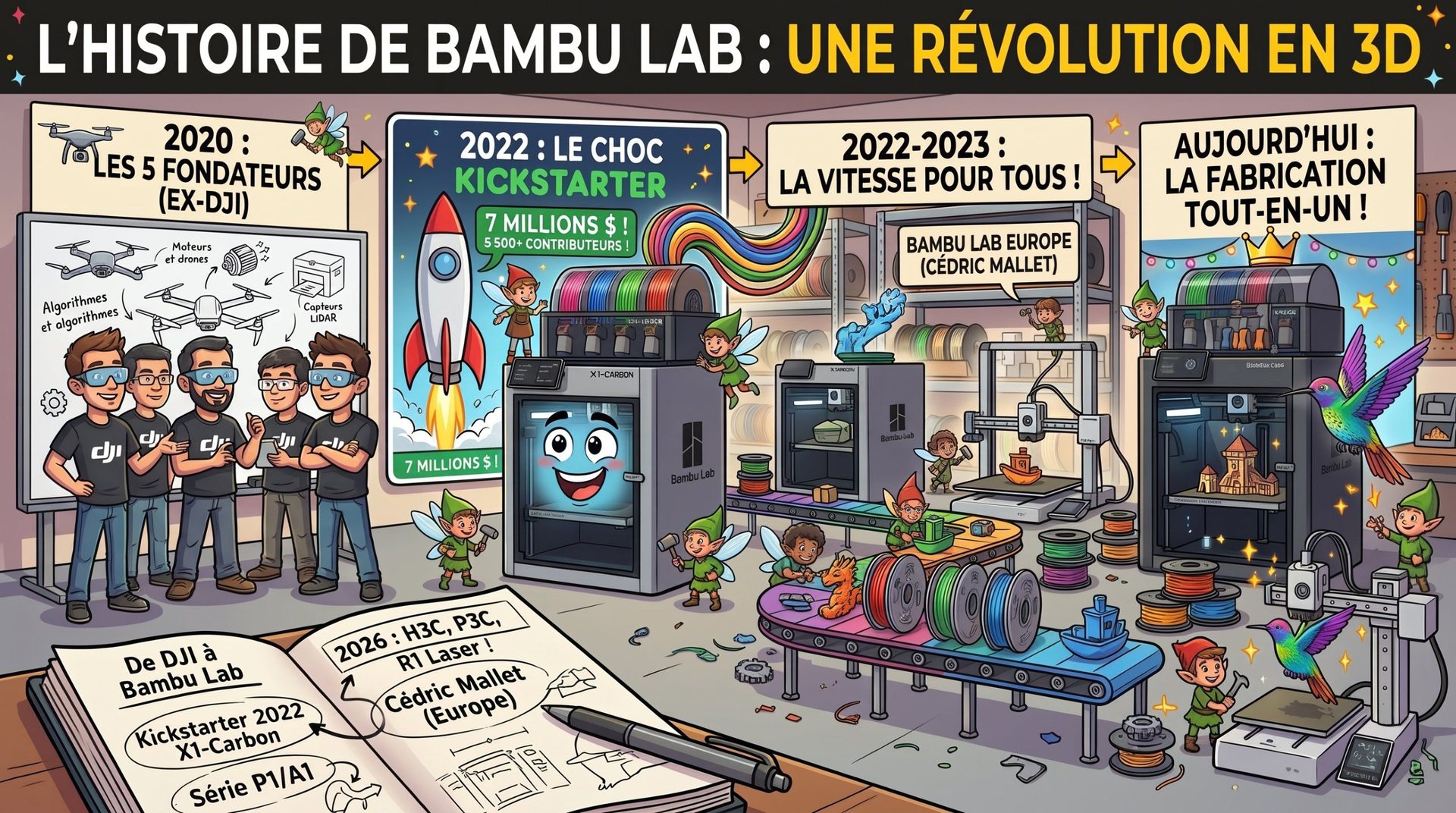
In just a few years, Bambu Lab (Chinese: 拓竹, Tuò zhú) went from unknown start-up to the world’s number one in desktop 3D printing. In an industry that had long been stuck with slow machines demanding hours of tinkering and calibration, the brand set a new standard: speed, automation and ease of use.
Here is the story of the company, its founders and how it has grown to where it is today.
1. The origins: DJI drone DNA applied to 3D printing
Bambu Lab’s story begins in 2020 in Shenzhen, China. The company was founded by five engineers from DJI, the world’s leading consumer drone maker.
At the helm is Dr Ye Tao (CEO), formerly head of DJI’s consumer drone division. Alongside him are Gao Xiufeng (CTO), who ran systems engineering at DJI, and Liu Huaiyu (COO), formerly product manager for DJI’s FPV goggles and drones.
The first twenty employees were all engineers, and their starting point was simple: home 3D printing suffered from the same flaws as the early drones of the 2010s. It was for tinkerers only, slow and unreliable. The goal was clear: bring their expertise in compact motors, sensors, vibration compensation and software integration to a truly “ready-to-use” 3D printer.
2. 2022: the Kickstarter earthquake with the X1 series
After almost two years of development behind closed doors, Bambu Lab went public at the end of May 2022 with a Kickstarter campaign for its first machine: the Bambu Lab X1, also available as the X1-Carbon.
The campaign raised the equivalent of about 7 million dollars from more than 5,500 backers, a record for a 3D printer at the time, and sent shockwaves through the industry. For the first time on a consumer machine, everything came as standard:
- very fast CoreXY motion with active vibration compensation;
- a LiDAR sensor to inspect the first layer and calibrate flow automatically;
- a camera paired with AI able to spot “spaghetti” (failed prints);
- the AMS (Automatic Material System), a 4-spool unit that, by linking up to four of them, prints up to 16 colours or materials automatically.
3. Explosive growth: speed and colour for everyone
Backed by investors such as IDG Capital (later joined by Temasek, 5Y Capital and others) and riding on the success of the X1-Carbon, the brand quickly rolled out a full line-up for every budget and use:
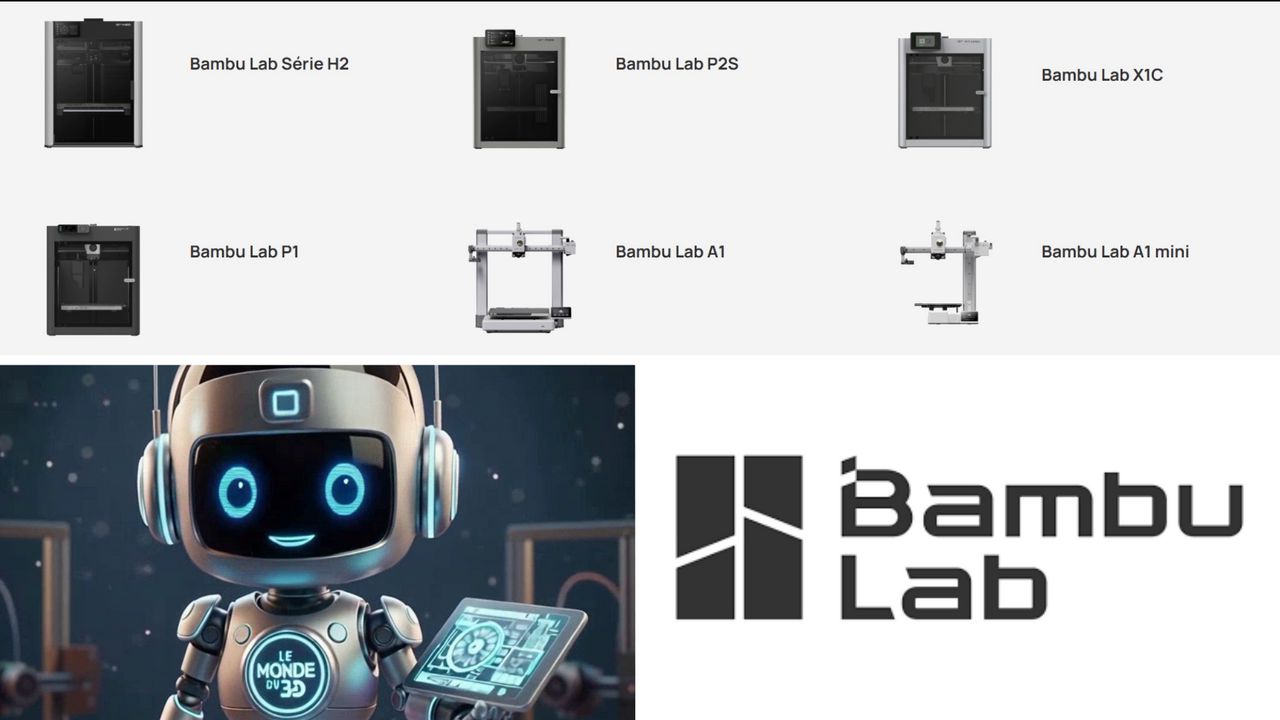
- Late 2022 – 2023, the P series: the P1P and then the P1S bring the X1-Carbon’s speed and print quality to a more affordable format. They become the favourite machines of print farms.
- Late 2023, the A series: launch of the A1 mini and then the A1, open bed-slinger printers that are very quiet, with quick-swap nozzles and the AMS Lite. Multicolour printing becomes accessible to everyone.
- The software ecosystem: alongside the hardware, Bambu Lab builds a closed but remarkably effective ecosystem around the Bambu Studio slicer, the Bambu Handy mobile app and the MakerWorld model-sharing platform.
Europe follows with the creation of Bambu Lab Europe, led by Frenchman Cédric Mallet.
4. Bambu Lab today: towards all-in-one personal manufacturing
Today, Bambu Lab is no longer just a 3D printer maker. It has become a major player in personal and professional manufacturing: according to the analyst firm CONTEXT, in 2025 it was the world’s top seller of 3D printers under $2,500, with around 37% of shipments. It has R&D centres in Shenzhen and Shanghai, an office in Austin (Texas), and opened its first physical store in Shenzhen, with stores announced in the United States.
The line-up has grown considerably with a new generation of versatile machines:
- The H series (H2D, H2S, H2C, H3C): large-format platforms. The H2D combines dual nozzles, laser engraving and cutting on one machine; the H2C adds Vortek automatic nozzle switching; the H3C moves to a true Swaptek tool changer with 9 heads.
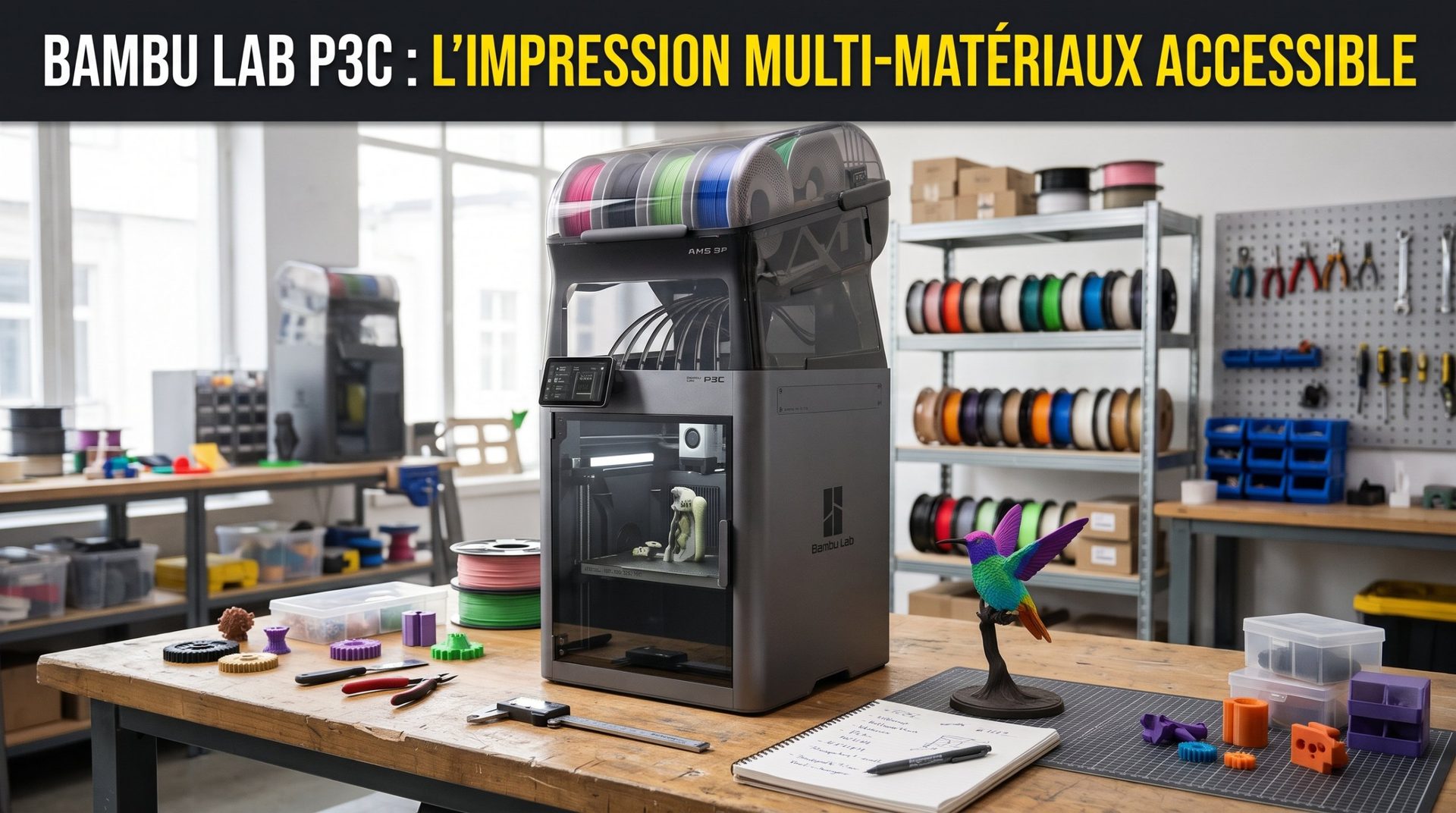
- Refreshed classic ranges: the P2S, X2D and A2L, then the recent P3C with its 7-slot Swaptek tool changer.
- Beyond 3D printing: the R1, a standalone laser cutter and engraver (55 W CO₂ laser).
The brand sometimes sparks debate in the open-source community, especially over cloud dependence and some locked-down protocols. But its impact is undeniable: Bambu Lab has forced the whole 3D printing industry to innovate at full speed.
And you, how did you first get into Bambu Lab?
From the legendary X1-Carbon on Kickstarter to the latest multi-tool machines: which printer introduced you to the brand, and how do you see 3D printing evolving over the next few years?